
If you’ve spent any time browsing mattresses, you’ve probably noticed the same three terms coming up again and again: memory foam, hybrid, and pocket sprung. They’re used so often, and with so much confidence, that it’s easy to assume the differences are obvious. In reality, they’re not always as clear as they seem.
In this guide, we’ll break down what each construction actually does, where it works well, where it doesn’t, and most importantly, how to work out which one is right for your body, sleeping position, and what you want from a mattress. Clear, practical guidance, without overcomplicating it.
Memory foam mattresses
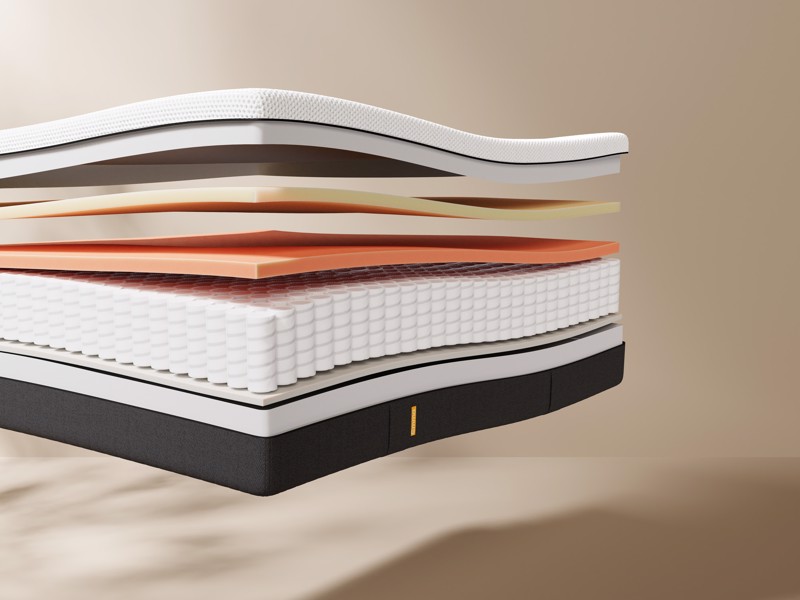
Memory foam, technically known as viscoelastic foam, responds to both heat and pressure. When you lie down, the warmth of your body softens the foam at the points of contact, allowing it to mould closely to your shape. This means your weight is distributed more evenly across the surface, rather than being concentrated at the shoulders and hips.
That even distribution is what gives memory foam its standout pressure relief. It supports the natural curve of the spine while cushioning the areas that tend to carry the most load.
It also absorbs movement rather than transferring it across the mattress. If you share a bed, this makes a noticeable difference, as movement on one side is far less likely to disturb the other.
- ✓ Excellent pressure relief that reduces load at shoulders, hips and joints
- ✓ Very strong motion isolation, ideal for couples
- ✓ Close contouring supports spinal alignment
- ✓ Quiet, with no springs or movement noise
- ✓ Naturally hypoallergenic and resistant to dust mites
- – Can retain heat, although gel or graphite versions improve this
- – Slower response can make repositioning feel less effortless
- – May feel too soft for heavier sleepers depending on tension
- – New foam can have a temporary smell when first unpacked
- – Not suited to those who prefer natural materials
Pocket sprung mattresses
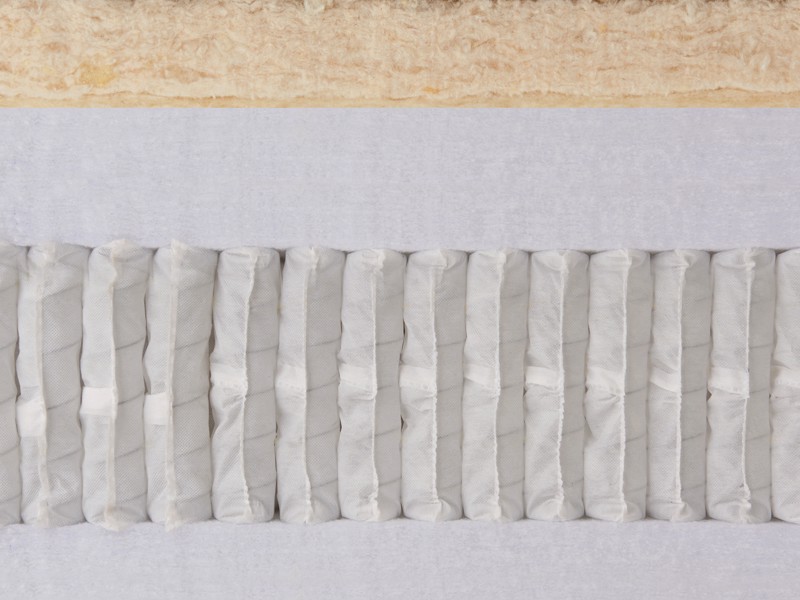
A pocket sprung mattress is built around individual steel springs, each housed in its own fabric pocket. This allows every spring to respond independently to the pressure applied directly above it, rather than reacting as a single unit across the whole mattress.
This is what gives pocket sprung mattresses their more responsive feel. The springs adjust to your body weight and sleeping position in real time, creating a supportive surface that adapts as you move rather than contouring slowly around you.
The open structure of the spring unit also allows air to circulate freely through the mattress, which helps regulate temperature and keeps the sleep surface feeling cooler. It is also the foundation for most natural mattresses, with fillings such as wool, cotton, silk and cashmere layered above the springs.
- ✓ Excellent temperature regulation due to airflow through the spring structure
- ✓ Responsive feel that makes moving and repositioning easier
- ✓ Good motion isolation compared to open coil mattresses
- ✓ Wide range of tensions available, from soft to extra firm
- ✓ Works well with natural comfort fillings
- ✓ Durable construction with long-term support
- – Pressure relief depends on the comfort layers above the springs
- – Can feel firmer if comfort layers are shallow or less cushioned
- – Motion isolation is good but not as strong as memory foam
- – Often heavier than foam alternatives
- – Some models require regular turning or rotation
Hybrid mattresses
A hybrid mattress combines a pocket spring support base with foam, latex, or gel comfort layers. The springs provide structure and support, while the layers above handle pressure relief and cushioning.
In a well-designed hybrid, this creates a more balanced feel. You get the responsiveness and airflow of pocket springs, alongside the pressure relief and contouring of foam. It is why hybrids are often the most widely recommended option for people who are not quite sure which direction to go in.
One thing worth knowing is that not all hybrids are built the same. Some use a deep spring unit with meaningful comfort layers above, while others are closer to a traditional spring mattress with a thin foam layer on top. The difference shows in how the mattress feels and performs, so it is worth checking how much of each material is actually being used.
- ✓ Combines pressure relief with structured support
- ✓ More breathable than pure memory foam
- ✓ Easier to move and reposition on during the night
- ✓ Good motion isolation for most sleepers
- ✓ Suits a wide range of sleeping positions and preferences
- ✓ Durable construction with long-term support from the spring base
- – Motion isolation is good but not as strong as pure memory foam
- – Can be heavier than foam-only mattresses
- – Quality varies depending on materials and construction
- – Typically more expensive than entry-level foam or spring options
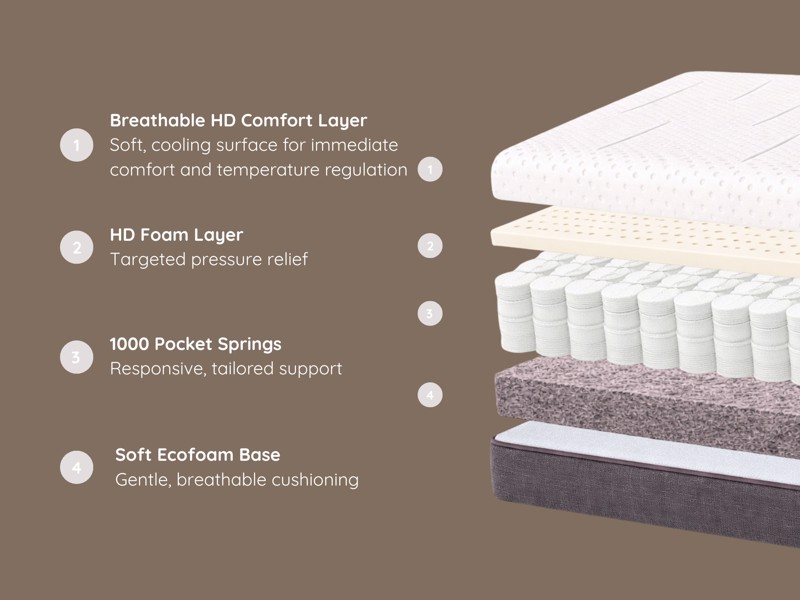
A well-designed hybrid brings these two needs together, offering pressure relief from the comfort layers and improved airflow from the spring base. In practice, that balance is something single-material constructions often struggle to achieve.”
Side by side: the full comparison
| Memory foam | Pocket sprung | Hybrid | |
|---|---|---|---|
| Pressure relief | Excellent – distributes weight evenly and cushions hips and shoulders | Good – depends on the comfort layers above the springs | Excellent – comfort layers provide strong pressure relief |
| Motion isolation | Best in class – movement is absorbed rather than transferred | Very good – independent springs reduce movement transfer | Very good – springs and comfort layers work together to limit movement |
| Temperature | Can retain heat – gel or graphite versions improve airflow | Excellent – open spring structure allows airflow | Very good – more breathable than foam-only mattresses |
| Responsiveness | Slower response – more effort to reposition | Immediate – springs respond and recover quickly | Immediate – spring base adds responsiveness |
| Natural fillings | Synthetic base – gel or graphite may be added | Best match – works naturally with wool, cotton, silk and latex | Compatible – natural layers can be used above spring base |
| Durability | Good – higher density foams last longer | Excellent – steel springs maintain long-term support | Excellent – spring core supports long-term structure |
| Weight | Lighter – easier to move and rotate | Heavier – especially with dense natural fillings | Heavier – combined materials increase weight |
| Noise | Silent – no springs | Occasionally – can develop noise over time | Minimal – well-made hybrids are generally quiet |
| Best for | Side sleepers, joint pain, very light sleepers | Hot sleepers, combination sleepers, natural material preference | Couples, warm sleepers, those wanting a balance of comfort and support |
| Not ideal for | Hot sleepers without cooling layers, frequent movers | Those needing deep pressure relief without comfort layers | Tight budgets – well-made hybrids tend to cost more |
Which type should you choose? A decision guide
A side sleeper who runs warm will often do better with a hybrid. A back sleeper who prefers natural materials and sleeps cool may lean towards a pocket sprung mattress. It always comes back to how you sleep, rather than the label on the mattress.”
Does it really come down to personal preference?
You’ll hear this phrase a lot when shopping for mattresses: “it really comes down to personal preference.” There’s some truth in it, but it’s often used in place of a clearer answer when one is actually possible.
Some parts of choosing a mattress genuinely are about preference. Whether you like the close, contouring feel of memory foam or the more traditional, on-top feel of a pocket sprung mattress is personal. The same goes for whether you prefer the plushness of natural fillings or the consistency of foam. These are differences in feel, and there isn’t a single right answer.
But other parts of the decision are less subjective and have a clearer answer based on how your body works. A side sleeper needs pressure relief. Someone who sleeps warm will struggle on a mattress that holds heat. If you share a bed with a restless partner, motion isolation becomes important. These aren’t preferences so much as practical requirements.
The approach we take at Land of Beds is to work through those factors first: how you sleep, your body weight, whether you tend to run warm, and whether you share a bed. Once that’s clear, personal preference becomes the final layer, helping you choose between different feels, materials, and price points within the options that are already right for you.
Frequently asked questions
It is worth looking closely at product descriptions. A well-made hybrid will clearly outline both the spring system and the depth and type of comfort layers used.
As a general guide, a good memory foam mattress lasts around seven to ten years. A well-made pocket sprung or hybrid mattress can last longer with proper care and regular rotation. Overall construction quality matters more than the type alone.
For lower back support, particularly for back sleepers, a medium to firm pocket sprung or hybrid mattress is often more suitable. A well-designed hybrid can combine both support and pressure relief, which is why it is frequently recommended for more complex needs.
If noise develops over time, it is usually a sign of wear rather than a normal characteristic of the construction.
For adjustable beds, it is always best to check compatibility, as some thicker hybrids and traditional pocket sprung mattresses are not designed to flex.
If one partner is particularly sensitive to movement, memory foam provides the strongest motion isolation. Where partners have very different firmness preferences, a zip and link mattress allows each side to be tailored individually.
Explore each type at Land of Beds
We stock mattresses across all three constructions, with options for every tension, size, and budget. Whether you’re looking for something simple or a premium handmade design, our team can help you match the right construction to how you actually sleep.
Call us on 01928 242829, visit our showrooms in Greater Manchester and Cheshire, or browse online.

Written by Alice Littler
Alice brings a background in marketing, design, and branding to Land of Beds, where she focuses on making sleep advice simple, relatable, and practical for everyday life. She holds a degree in Graphic Design with a specialism in branding and design, giving her a strong understanding of how interior spaces, colour, layout, and environment can influence comfort, mood, and overall wellbeing.
Her creative background allows her to provide both expert bed and mattress guidance and bedroom design inspiration that helps customers create spaces that feel as good as they look.
Alongside her work in marketing and branding, Alice has collaborated with internationally recognised brands including Campari and Aperol, Paulaner, and Malfy, helping develop her expertise in consumer-focused communication and lifestyle content. She has also been trained by and works closely with leading UK bed and mattress manufacturers including Harrison Spinks, Hypnos, and Vispring, building extensive knowledge of mattress technology, sleep ergonomics, bedroom comfort, and sleep wellness.
Passionate about the life-changing impact of quality sleep, Alice creates content designed to help readers make informed decisions to improve their sleep environment, wellbeing, and everyday routine.