
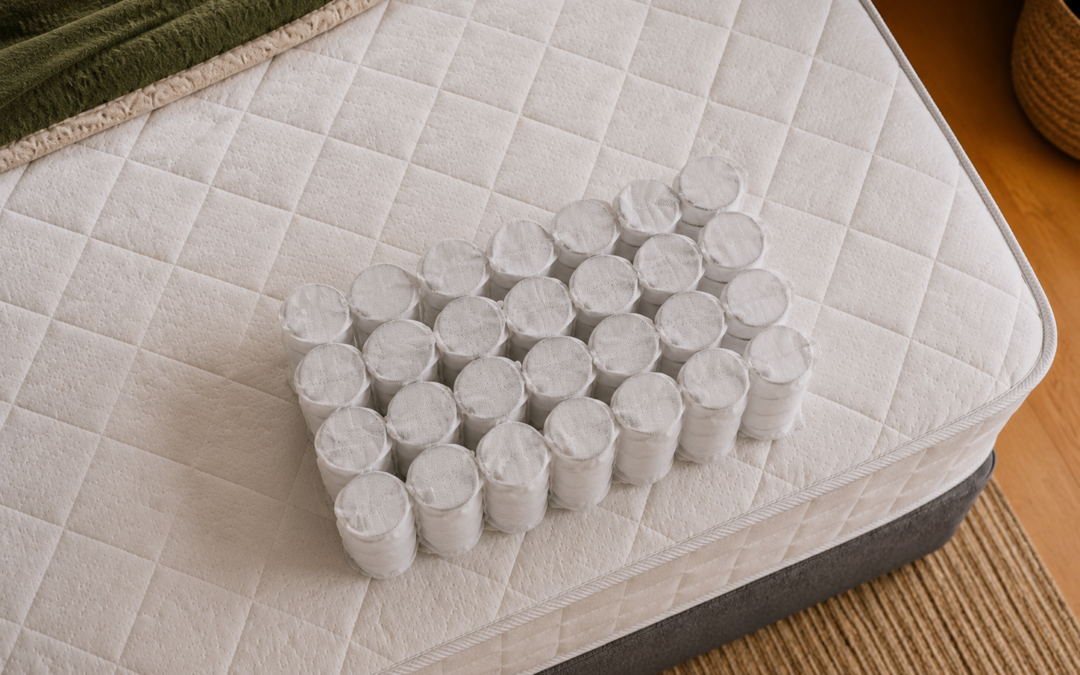
Pocket sprung mattresses are one of the most common options you’ll come across when you start shopping, often talked about as if everyone already knows exactly what it means. In reality, most people don’t. Not fully.
And it matters more than you might think. Because once you understand how a pocket sprung mattress actually works, how it supports your body, how it differs from memory foam or hybrid designs, and why spring count alone doesn’t tell the full story, choosing the right one becomes far more straightforward.
In this guide, we’ll explain exactly what a pocket sprung mattress is, what it does well, where it may not be the right fit, and which pocket sprung mattresses we would recommend depending on how you sleep. No jargon, no assumptions, just straightforward advice from people who spend every day helping customers find the right mattress at Land of Beds.
What is a pocket sprung mattress and how does it work?
The mechanics are simple once you see them, and understanding them makes every other decision easier.
A pocket sprung mattress is built around a system of individual steel springs, each one enclosed in its own separate fabric pocket. That is the defining feature, and the reason pocket sprung mattresses behave differently from other spring systems. The pockets keep each spring independent from its neighbours.
When you lie down, each spring responds only to the pressure applied directly above it. The spring beneath your hips compresses according to your weight. The spring beneath your shoulders responds to your shoulders. The springs beneath lighter areas of your body, such as your lower legs, compress far less. The result is a support profile that adapts across the entire surface of the mattress, following the shape and weight distribution of your body.
This same independence is what gives pocket sprung mattresses their well-known motion isolation. When your partner moves during the night, the springs beneath them respond to that movement, but it does not transfer across the mattress. The springs under you remain unaffected, so your sleep is less likely to be disturbed. For couples, this is one of the most practical benefits of a pocket sprung mattress, and one that is difficult to match with other constructions.
Together, this allows a single spring to provide both cushioning comfort and structured support. It is a simple but highly effective piece of engineering, and one that has been refined over decades rather than replaced.
Pocket sprung vs open coil: what’s the actual difference?
Both are classed as “spring mattresses”, but they work in very different ways, and that difference becomes especially important if you share a bed.
| Pocket sprung | Open coil | |
|---|---|---|
| How springs work | Each spring moves independently within its own fabric pocket | Springs are connected in a continuous unit and move together |
| Motion isolation | Very good. Movement tends to stay on one side of the mattress | More limited. Movement can travel across the mattress |
| Body contouring | More tailored. Each spring responds to pressure in specific areas | More uniform. Support is spread evenly across the surface |
| Durability | Often longer lasting, as individual springs retain their shape | Can show wear more quickly as connected springs share pressure |
| Price | Typically higher due to more complex construction | Generally more accessible at lower price points |
| Best for | Couples, those wanting more precise support, long-term use | Solo sleepers, guest rooms, or more occasional use |
The short version: if you share a bed, open coil mattresses are usually not the most practical choice, as movement can transfer more easily across the surface. If you sleep alone and are working within a tighter budget, they can still be a sensible option. For most people looking for a balance of comfort, support, and long-term performance, a pocket sprung mattress tends to be the better fit.
What does spring count actually mean and does it really matter?
This is probably the number you’ll see mentioned most often when shopping for a mattress, and one of the least clearly explained.
A higher spring count means more individual springs within the mattress. In practice, that usually means smaller springs packed more closely together, creating a more responsive and detailed level of support across the surface. A mattress with 2000 springs will generally adapt more closely to the shape of your body than one with 800, simply because there are more individual points responding to your weight.
But there are a few important details that are not always explained clearly.
Spring count is almost always quoted for a king size mattress. When you see a mattress listed as having 2000 pocket springs, that refers to the king size version. A double of the same model will have fewer springs, and a super king will have more. This is consistent across the industry, so it is useful when comparing like-for-like sizes, but less meaningful as a standalone number.
A higher spring count does not automatically mean a firmer mattress. A mattress with 3000 lower-tension springs can feel noticeably softer than one with 800 higher-tension springs. The wire tension determines how firm the mattress feels, while the spring count affects how precisely it responds to your body. They work together, but they are not the same thing.
Finally, the comfort layers above the springs matter just as much as the springs themselves. A high spring count combined with lower-quality fillings will not perform well overall. The springs provide support, while the fillings influence comfort, temperature regulation, and pressure relief. Both elements need to work together for the mattress to feel and perform as it should. This is why two mattresses with the same spring count can feel completely different in practice.
| Spring count (king) | What it means | Best for |
|---|---|---|
| Under 1000 | Entry-level support with larger individual springs and a broader response across the surface | Guest rooms, children’s beds, and more budget-conscious buyers |
| 1000 to 1500 | A solid mid-range option with good individual response for most sleepers | Most solo sleepers and couples looking for a reliable everyday mattress |
| 1500 to 2500 | More refined support with improved contouring and better motion isolation | Couples, back sleepers, and those thinking longer term |
| 2500+ | Highly responsive support, often combined with additional mini springs in the comfort layer | Those who want the most detailed support and a more premium feel |
The honest pros and cons of pocket sprung mattresses
- Outstanding motion isolation. One of the most practical benefits for couples sharing a bed, and difficult to replicate with other constructions.
- Individualised spinal support. Each spring responds to your specific body shape rather than applying a uniform feel across the surface.
- Excellent temperature regulation. The open spring structure allows air to circulate more freely, helping pocket sprung mattresses feel cooler than many foam alternatives.
- Available in a wide range of tensions, from soft through to extra firm, making it easier to match the mattress to your body and sleeping position.
- Works with a wide variety of comfort fillings, including natural fibres, latex, gel, and memory foam, offering flexibility in feel and price.
- Durable construction. High-quality pocket springs can maintain their support over time, particularly when the mattress is rotated regularly.
- Responsive feel. Repositioning during the night is easier compared to slower-response materials like memory foam.
- Heavier than foam mattresses, which can make them more difficult to move or rotate, particularly at higher spring counts or with dense natural fillings.
- Motion isolation, while very good, may not fully match memory foam for very light sleepers who are sensitive to small movements.
- Pressure relief depends on the quality of the comfort layers above the springs. A high spring count with poor fillings will not perform well overall.
- Lower-quality models may use thinner wire that loses tension over time, so construction quality is just as important as spring count.
- Can become noisy as the mattress ages if springs or fabric pockets begin to wear, which may indicate it is time to replace it.
Who pocket sprung mattresses genuinely suit and who they don’t
Pocket sprung vs memory foam vs hybrid
| Pocket sprung | Memory foam | Hybrid | |
|---|---|---|---|
| Motion isolation | Very good | Best in class | Very good |
| Pressure relief | Good. Depends on the quality of the comfort layers | Excellent | Excellent |
| Temperature | Excellent. Open spring structure allows airflow | Can retain heat depending on materials used | Very good overall balance |
| Responsiveness | Immediate. Easy to reposition | Slower response with a more cushioned feel | Responsive with some contouring |
| Natural fillings | Well suited. Often paired with natural materials | Typically synthetic by design | Can incorporate both natural and synthetic layers |
| Durability | Excellent with good construction | Good. Can vary depending on foam density | Excellent when well built |
| Best for | Couples, hot sleepers, back sleepers, natural materials | Side sleepers, pressure relief, those sensitive to movement | Most sleepers looking for a balance of support and comfort |
Our picks: the best pocket sprung mattresses at Land of Beds
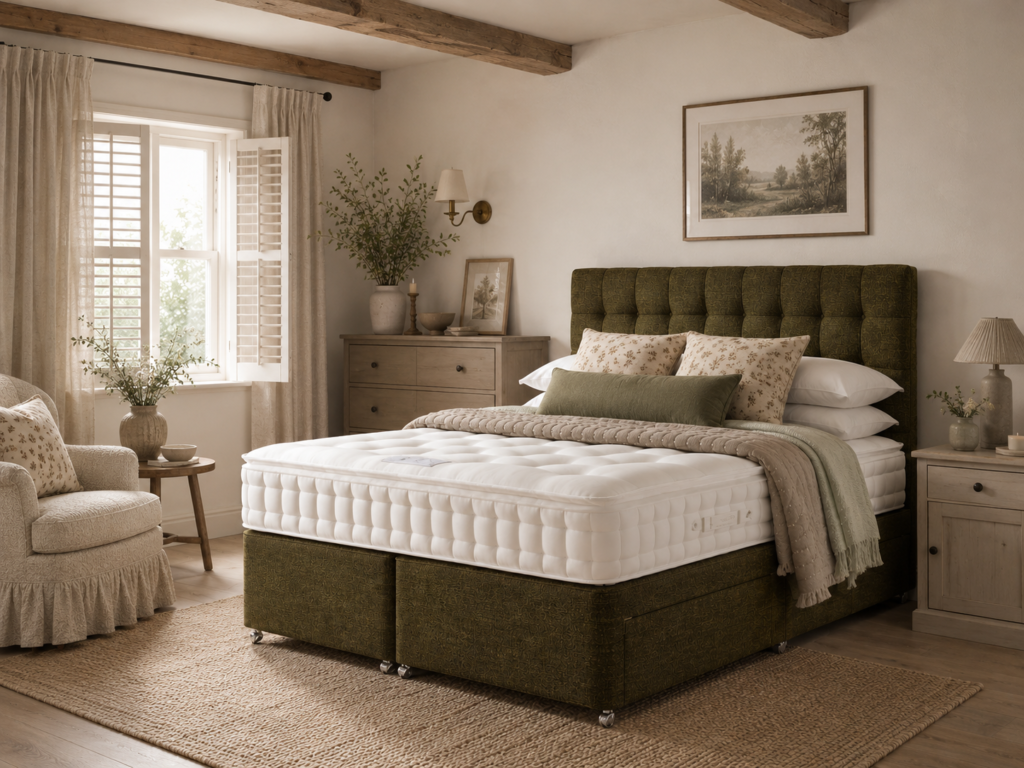
It suits those who want a more traditional, natural mattress with reliable support and a cooler sleep surface, particularly for back sleepers and anyone who tends to sleep warm.
It is particularly well suited to those looking for a dependable everyday mattress that offers the key benefits of pocket springs without moving into higher price brackets.
It is a strong option for side sleepers or anyone who wants a slightly softer feel than a traditional pocket sprung mattress, without moving fully into memory foam.
Pocket sprung mattress FAQs: your most common questions answered

Written by Alice Littler
Alice brings a background in marketing, design, and branding to Land of Beds, where she focuses on making sleep advice simple, relatable, and practical for everyday life. She holds a degree in Graphic Design with a specialism in branding and design, giving her a strong understanding of how interior spaces, colour, layout, and environment can influence comfort, mood, and overall wellbeing.
Her creative background allows her to provide both expert bed and mattress guidance and bedroom design inspiration that helps customers create spaces that feel as good as they look.
Alongside her work in marketing and branding, Alice has collaborated with internationally recognised brands including Campari and Aperol, Paulaner, and Malfy, helping develop her expertise in consumer-focused communication and lifestyle content. She has also been trained by and works closely with leading UK bed and mattress manufacturers including Harrison Spinks, Hypnos, and Vispring, building extensive knowledge of mattress technology, sleep ergonomics, bedroom comfort, and sleep wellness.
Passionate about the life-changing impact of quality sleep, Alice creates content designed to help readers make informed decisions to improve their sleep environment, wellbeing, and everyday routine.