
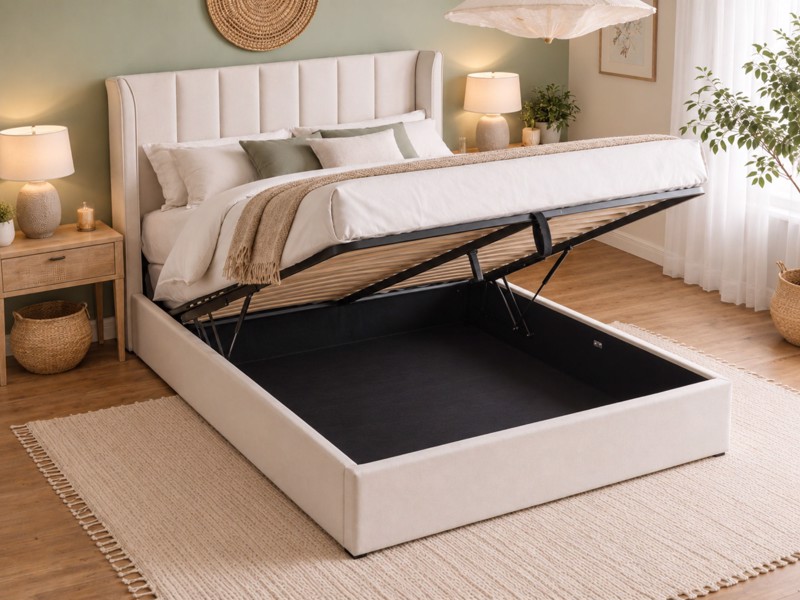
If your bedroom is short on storage, an ottoman bed can be one of the cleverest ways to make better use of the space you already have.
Instead of drawers taking up extra room around the sides of the bed, the mattress platform lifts to reveal a large hidden storage area underneath. From choosing between side and end lift to measuring your room and checking mattress compatibility, here’s what to know before you buy.
Quick Answer
An ottoman bed is a bed with a lift-up base and storage underneath the mattress. Most use a gas-assisted mechanism to make opening the base easier. Choose a side-lift design if access is easier from the side of your bed, or an end-lift design if you have more space at the foot. Before buying, measure the room carefully and check the manufacturer’s guidance for mattress weight, storage capacity and assembly.
What Is an Ottoman Bed?
An ottoman bed is a storage bed with a base that lifts upwards to reveal a compartment beneath the mattress. The lifting action is usually supported by gas struts or a similar assisted mechanism, helping take much of the effort out of raising the base.
Because the storage sits underneath the full sleeping area, an ottoman can give you considerably more hidden space than a bed with a couple of drawers. It can be particularly useful in smaller bedrooms where adding another chest of drawers or wardrobe isn’t practical.
Expert Advice
“I always recommend ottoman beds for anyone with limited space. In many UK homes, storage can be a challenge, and these beds provide a stylish and practical solution,” says Julie, Bed and Mattress Expert at Land of Beds.
Side Lift or End Lift: Which Should You Choose?
The biggest decision is usually where you want the bed to open from. Neither option is automatically better. It depends on your room layout and where you have the easiest access.
| Lift type | Best for | Think about |
|---|---|---|
| Side lift | Bedrooms where one side of the bed is easy to access. | Doors, bedside tables, radiators and the side the bed sits closest to. |
| End lift | Rooms with clear access at the foot of the bed. | Benches, walls, wardrobes or furniture positioned directly opposite the bed. |
Don’t Just Measure the Bed
Think about how you’ll actually stand beside the bed and reach into the storage compartment when it’s open. The exact clearance needed varies by model, so check the product dimensions rather than relying on a single universal measurement.
What Size Ottoman Bed Do You Need?
Ottoman beds are available in most standard UK bed sizes, so your choice should still begin with the amount of sleeping space you need and the size of your bedroom.
| Size | Often works well for | Useful storage for |
|---|---|---|
| Single | Children’s rooms and guest rooms | Bedding, clothes and toys |
| Small double | Compact bedrooms | Bedding, seasonal clothes and smaller luggage |
| Double | Most standard double bedrooms | Spare bedding, clothing and suitcases |
| King | Larger bedrooms and couples wanting more space | Duvets, pillows and bulky seasonal items |
| Super king | Spacious bedrooms | Larger quantities of bedding, clothing and luggage |
Remember that the overall frame can be wider and longer than the mattress itself, particularly with upholstered designs and larger headboards. Always measure using the full external dimensions shown on the product page.
Upholstered or Wooden Ottoman Bed?
Storage is only half the decision. The bed still needs to suit the look and feel of your bedroom.
Upholstered Ottoman Beds
Upholstered frames give you plenty of choice in colour, texture and finish, from soft neutrals to velvet and more statement fabrics. They’re a good option if you want the bed to feel softer and more decorative.
Wooden Ottoman Beds
Wooden designs offer a more structured look and can work particularly well in classic, Scandinavian or pared-back bedrooms. They can also be relatively straightforward to wipe clean and maintain.
You can browse our full range of ottoman beds to compare different styles and finishes.
What Can You Store in an Ottoman Bed?
Ottoman storage is particularly useful for things you want to keep nearby but don’t need every day, such as spare bedding, winter duvets, seasonal clothing and luggage.
- Spare pillows and duvet sets
- Out-of-season clothing
- Blankets and throws
- Suitcases and travel bags
- Towels and spare linen
- Children’s toys or occasional-use items
Keep the Storage Practical
Use boxes or breathable storage bags to keep smaller items organised, place things you use most often within easy reach and avoid exceeding the manufacturer’s stated storage limit.
Vacuum bags can be useful for bulky textiles, but don’t compress or overload the compartment so heavily that the base, floor panels or lifting mechanism are put under unnecessary strain.
Can You Use Any Mattress on an Ottoman Bed?
Ottoman beds can work with many common mattress types, including pocket sprung, memory foam, hybrid and latex mattresses. The important thing is to check the individual bed frame’s specifications.
The mattress contributes to the overall weight being lifted, and ottoman mechanisms are designed to operate within particular weight ranges. A mattress that is much heavier or lighter than recommended may affect how easily the base opens and closes.
Check These Three Things
- The correct mattress size for the frame
- The recommended mattress weight range
- Any manufacturer-specific mattress requirements
If you’re choosing a new mattress at the same time, explore our mattress range or speak to one of our bed and mattress experts for help matching the two.
What Safety Features Should You Look For?
A well-made ottoman bed should feel stable when opened and closed and should come with clear instructions for safe operation.
Useful things to check include:
- A smooth, controlled lifting mechanism
- A base designed to remain securely open while you’re accessing the storage
- Strong hinges and attachment points
- A sturdy frame and storage floor
- Clear weight and usage guidance from the manufacturer
- Availability of replacement components where applicable
Don’t Force the Mechanism
If an ottoman suddenly becomes much harder to lift, won’t stay open properly or appears uneven, stop forcing it and check the manufacturer’s instructions. A change in lifting action can be a sign that the mechanism needs adjustment or attention.
How Do You Look After an Ottoman Bed?
Ottoman beds don’t usually require complicated maintenance, but it is worth keeping an eye on the lifting mechanism and storage compartment as part of your normal bedroom routine.
- Keep the storage area clean and dry.
- Vacuum upholstered surfaces according to the care instructions.
- Check visible hinges and fixings periodically.
- Avoid placing more weight in the storage area than the manufacturer recommends.
- Open and close the bed using the designated handle or lifting point.
- Follow the manufacturer’s instructions if the gas struts or mechanism ever need replacing.
Gas-assisted mechanisms can gradually lose pressure with age and use. If the bed begins to feel noticeably heavier to lift or no longer stays open as intended, replacement struts may be required depending on the design.
Ottoman Bed FAQs
Are ottoman beds comfortable?
They can be just as comfortable as other beds. Comfort depends much more on the mattress, the type of base beneath it and whether the combination suits your sleeping preferences.
Are ottoman beds difficult to lift?
Most modern ottoman beds use an assisted lifting mechanism, so you shouldn’t be lifting the full weight of the mattress and base yourself. How heavy it feels will still vary according to the mattress and the specific mechanism.
How much can you put in an ottoman bed?
Capacity varies significantly between models. Check the product instructions for any maximum load rather than assuming all ottoman beds can hold the same weight.
Do ottoman beds need assembly?
Most do require assembly because the frame, lifting mechanism and mattress platform need to be fitted together correctly. Follow the manufacturer’s instructions carefully or choose an assembly service where available.
Do ottoman beds lose gas?
Gas struts can gradually lose pressure over time. If that happens, the bed may feel heavier to lift or may not remain open as confidently as it once did. Whether the struts can be replaced depends on the individual bed, so check with the manufacturer or retailer.
Ottoman Bed Buying Checklist
- Measure the full space available in your room.
- Decide whether side lift or end lift gives you easier access.
- Check the bed’s full external dimensions, not just the mattress size.
- Think realistically about what you want to store underneath.
- Check the storage and mattress weight guidance.
- Look at the quality of the frame, hinges and lifting mechanism.
- Check the warranty and availability of replacement parts.
- Choose a fabric, wood finish or colour you’ll be happy to live with long term.
- Read customer reviews for the model you’re considering.
Why Choose Land of Beds?
Land of Beds has been helping people find the right bed and mattress since 1974. As a third-generation family business, we know that choosing a bed isn’t just about how it looks. It needs to work for your bedroom, your storage needs and the way you sleep.
Speak to people who understand beds, mattresses and how the two work together.
Available on qualifying orders over £100.
Helping you buy with confidence when comparing like-for-like products.
Read thousands of verified customer experiences on Trustpilot.
You can shop ottoman beds online or visit our Helsby and Wigan showrooms if you’d prefer to see different styles in person.
The Bottom Line
An ottoman bed makes sense when you want more storage without giving up additional floor space. The best one for you comes down to three things: how much room you have, where you want the bed to open and what you plan to store inside it.
Measure carefully, check the mattress and weight guidance for the individual model and choose a mechanism you can access comfortably. Get those things right, and an ottoman bed can be one of the hardest-working pieces of furniture in your bedroom.
About This Article
Written by
Judith Ackers
Judith brings her background in psychology, neuroscience and education to her role at Land of Beds, where she shares expert advice to help customers sleep better. From product buying guides to bedtime routines and sleep-friendly habits, Judith’s insights support Land of Beds’ mission to improve sleep for everyone.
Last updated by
Alice Littler
Alice brings a background in marketing, design and branding to Land of Beds, where she focuses on making sleep advice simple, relatable and practical for everyday life. She works closely with leading UK bed and mattress manufacturers, building her knowledge of mattress technology, bedroom comfort and sleep wellbeing.
Article reviewed and updated October 2026.