
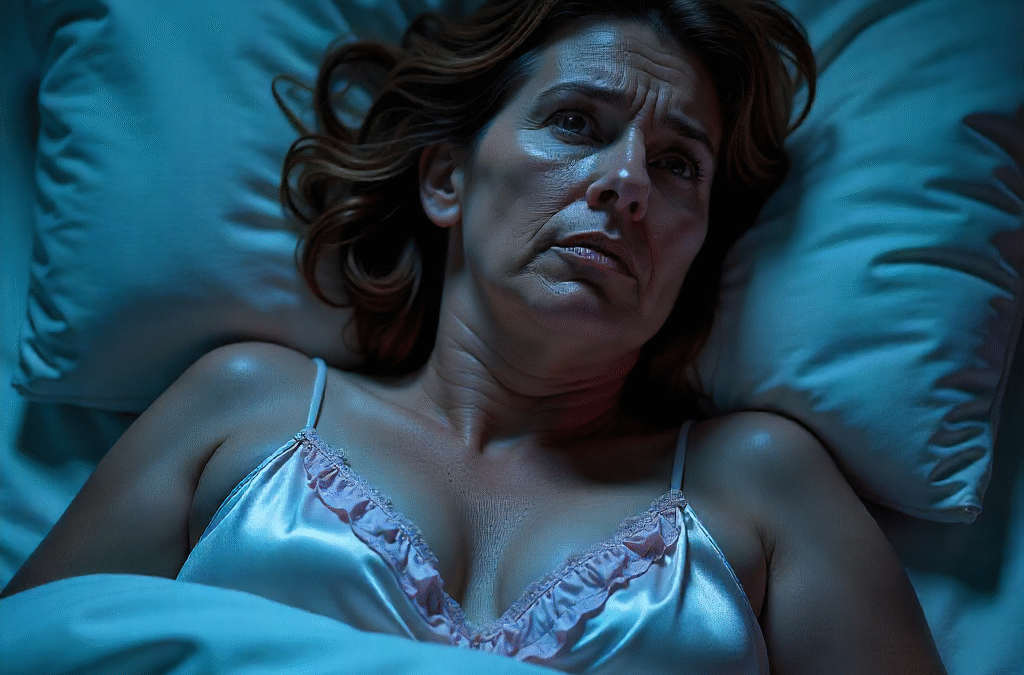
Dr Nerina Ramlakhan explains why so many women struggle at night and ways to help.
Menopause is a natural life stage, but for many women it can be one of the most disruptive and exhausting times, especially when it comes to sleep. Poor sleep is not just a nightly frustration; it affects every aspect of health, relationships, and overall wellbeing.
To better understand this, we surveyed 1,019 UK women about how menopause impacts their sleep, mental health, and relationships. We partnered with Dr Nerina Ramlakhan, a physiologist and sleep and energy expert, to provide guidance on navigating symptoms and improving sleep. Alongside the data, we include real, anonymous experiences shared by women in the survey, offering an honest insight into the reality of menopause and sleep.
The reality of menopausal sleep struggles
The survey revealed the main symptoms disrupting sleep during menopause:
- Waking up frequently – 58.5%
- Hot flushes – 50.7%
- Night sweats – 46.6%
- Anxiety or restlessness – 45.2%
- Insomnia – 41.4%
A staggering 40.4% of women experience these symptoms weekly. As a result, more than half (51.6%) rate their sleep quality as poor or very poor, with 65% getting fewer than six hours of sleep per night.
One of the women we surveyed explained, “I rarely have a full night’s sleep. I can lie awake for hours unable to get to sleep with anxiety and I have regular hot flushes/sweats through the night that make me have nightmares that wake me up.”
Another went on to say, “This is the worst time of my entire life. I have to keep cool to keep the flushes and night sweats under control and still have them. Constantly interrupted sleep makes me irritable in the day and very tearful.”
Why does menopause affect sleep?
Menopause can seriously disrupt sleep, leaving many women battling hot flashes, anxiety, and restlessness. Hormonal changes are at the heart of the problem, as Dr Nerina explains,
“The reason why sleep can be impacted during this phase of life is that the body produces increasingly less oestrogen and progesterone, the hormones involved in the reproductive cycle. To compensate for this the body starts to produce more of the stress hormones e.g. cortisol. These changes affect many systems and processes in the body, including several that impact sleep. Additionally, this is the life stage in which many stressful life events can occur – children growing older and elderly parent care. The combination can create a not so perfect storm within the body giving rise to menopausal sleep symptoms such as the ones highlighted in the survey – anxiety and mood changes, restlessness, difficulty thermoregulating and hot flashes and night sweats.”
In short, these biological shifts reduce the amount of restorative deep sleep women get, replacing it with lighter stages that leave them unrefreshed and fatigued.

The knock-on effects of poor sleep
The impact of disrupted sleep goes beyond the night. 64.9% of women reported changes in mood and emotional wellbeing due to poor sleep.
Women shared their experiences, saying:
- “The lack of sleep really affects my concentration during the day and the fatigue can be overwhelming. The dread when I wake up is impacting my quality of life a lot.”
- “The key issue is how anxious I feel when I’ve been lying awake dissecting things in my brain. It causes me to worry and depression can kick in as a consequence.”
- “It’s awful and affects every aspect of my life because without enough sleep everything feels so overwhelming like parenting and my marriage. I can’t live like this indefinitely, it’s ruining my life.”
Dr Nerina explained how lack of sleep effects our mood, explaining::
“Getting good sleep is vital – there is a reason why we are designed physiologically to spend around a third of our lives sleeping as sleep affects every aspect of our health. When we sleep well and restoratively the body is restored physically, emotionally, mentally and spiritually – we are happier, more vital, optimistic, and have a greater zest for life.
“Conversely, poor sleep during menopause can worsen mental health by increasing irritability, anxiety, and depressive symptoms. Insufficient sleep impairs emotional regulation, decision-making, and concentration, creating a vicious cycle in which hormonal shifts lead to poor sleep, which in turn intensifies mood problems. Addressing sleep challenges is crucial for improving both physical and mental well-being during this transition, particularly as this is a phase of life that often requires a great deal of mental and emotional resilience.”
Expert strategies for sleeping better through menopause
Dr Nerina Ramlakhan has developed a targeted approach to help women rest better.
“In my unique sleep methodology, I describe five non-negotiables that can help to reset the nervous system, leading to reduced anxiety and fewer hot flashes or awakenings at night.”
The Five Non-Negotiables
1. Eat a nutrient-rich breakfast within 30–45 minutes of waking
A balanced breakfast with protein, fat, and carbohydrates stabilises blood sugar and minimises cortisol. Example: full-fat Greek yoghurt with berries, nuts, and seeds.
“Unfortunately, many women skip this vital meal as hormonal changes, particularly decreasing oestrogen, can cause weight gain. There is also conflicting advice about intermittent fasting and skipping breakfast. For peri-, post- and menopausal women this can be a disaster, leading to increased cortisol, lower energy, and ironically, weight gain,” says Dr Nerina.
2. Minimise stimulants
Caffeine, alcohol, and smoking interfere with sleep and can intensify hot flashes. Dr Nerina recommends no more than one cup of tea or coffee per day, and avoiding caffeine after midday.
3. Stay hydrated
Around two litres of water daily supports brain function and reduces night sweats.
4. Prioritise bedtime consistency
Going to bed around 9:30–10pm works with the body’s optimal circadian rhythm.
5. Create healthy tech boundaries
An “electronic sundown” at least 1–1.5 hours before bed, leaving phones and tablets outside the bedroom, and avoiding late-night screen use all help protect sleep quality.
Coping With Night Wakings
For women who wake frequently at night, Dr Nerina recommends:
- Reassure yourself: Night wakings are normal! Most people experience 10–15 micro-awakenings per night.
- Avoid clock-watching: Looking at the time can trigger anxiety and full alertness.
- Use relaxation techniques: Gentle breathing or a body scan can help ease the body back into rest.
- Focus on resting, not sleeping: “Don’t try to force sleep,” says Dr Nerina. “Shift the focus to resting instead, and sleep often follows naturally.”

Supplements and treatments
Over a third of women (38.3%) admitted to have spent money trying to improve sleep. The most common spends include:
- Sleep aids or supplements – 72.2%
- Blackout blinds or fans – 50.4%
- Cooling bedding – 43.6%
- Hormone Replacement Therapy – 27.3%
Dr Nerina advises:”Many women find that taking hormone replacement can significantly reduce symptoms and discussing this option with a medical doctor is a good step. Increasingly, women are also turning to the use of natural supplements and although the research outcomes are still unclear, for many it can be worth exploring. These include omega-3 fish oils, vitamin D, probiotics and magnesium. Magnesium glycinate can be helpful for enabling more restful sleep.
Additionally, fibre supplements, B vitamins, and certain herbal remedies like black cohosh and maca root. Both of these are known as adaptogens, a class of natural substances, primarily from plants and mushrooms, that are believed to help the body cope with stress and restore balance. They are not meant to prevent stress, but rather to improve the body’s response to stress once it occurs. Adaptogens are thought to work by modulating the body’s stress response system. The adaptogen ashwagandha can help to restore hormonal imbalances, particularly during the menopause. It helps to support the endocrine system and reduce symptoms such as hot flushes, night sweats and mood swings.”
Relationships, intimacy and the sleep divorce debate
Menopause symptoms can affect relationships. Our survey found:
- 41.7% of women in relationships sleep separately due to menopause symptoms
- 56.6% say symptoms affect intimacy with their partner
Women shared their experiences, explaining:
- “It has made me grumpy on a regular basis and it has led to a significant reduction in intimacy in my relationship.”
- “I have become very sensitive to noise and can’t sleep if I hear my partner breathing or snoring and will go to the spare room to try to sleep.”
Dr Nerina observes:”I am finding that more women who are navigating menopause symptoms are reporting that they need to sleep separately from their partners… Women need more rest during menopause so I am finding that a lot of women are becoming more ‘hardnosed’ about needing to protect their sleep and often this means separate sleeping. While this can help, it does need to be navigated mindfully and sensitively.”
For those looking to improve their sleep and intimacy with their partners, Nerina suggests the following:
Invest
“Get the biggest bed that can fit into the bedroom, ideally designed so that a partner’s movements do not disturb. Change the mattress every seven years or so as it loses its elasticity and supportive properties. Separate duvets are good if one of the couple is a duvet hogger, and white noise or at least a fan in the room can act as a buffer to some extent against intrusive snores and snuffles.”
Conscious communication
“The hormonal changes accompanying menopause can make the nervous system more sensitive and communicating this diplomatically and lovingly to one’s partner is important. Find a way to communicate that sleeping separately might be necessary at times. The emphasis in the communication should be on building trust and being able to share openly without blame.”
Practice sleeping together
“For example, practice having a nap together. These naps could be done over the weekend, for no longer than 20–30 minutes at a time and at some point between 2 and 4pm so that nighttime sleep is not affected.”
Conclusion
Menopause isn’t just about hot flushes and hormonal changes, sleep disruption is equally transformative. Poor sleep affects mood, energy, concentration, and relationships.
The good news? With targeted strategies, supportive treatments, and mindful communication, women can reclaim restorative sleep and build resilience during this life stage.
Methodology
1,019 UK women currently experiencing perimenopause and menopause were surveyed using Land of Beds’ internal customer database and third party tool, Pollfish.
Data correct from August 2025.
About Dr Nerina
Dr Nerina Ramlakhan is a physiologist and renowned sleep expert with over 25 years of experience helping people and organisations improve their sleep, resilience, and wellbeing.
Early in her career, she observed how modern life – driven by technology, globalisation and relentless pressure – was leaving many of her clients exhausted, burned out, and disconnected.
Her work is deeply rooted in both science and lived experience. After facing her own personal challenges, including a diagnosis of bipolar disorder and complex PTSD in her early 30s, Dr Nerina embarked on a profound healing journey. Through this, she discovered the power of making different choices and now uses that insight, along with science and philosophy, to help others sleep more deeply, overcome adversity and rediscover joy in everyday life.

Written by Judith Ackers
Judith brings her background in psychology, neuroscience, and education to her role at Land of Beds, where she shares expert advice to help customers sleep better. From product buying guides to bedtime routines and sleep-friendly habits, Judith’s insights support Land of Beds’ mission to improve sleep for everyone.