
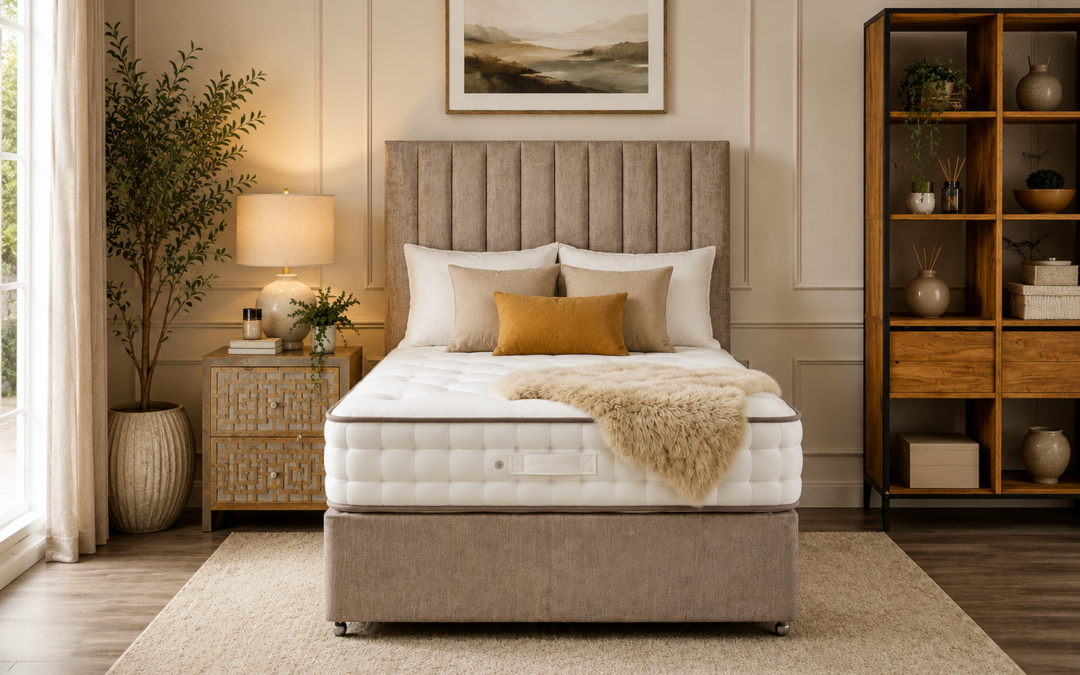
King size mattresses are becoming increasingly popular as people prioritise extra sleeping space and comfort, and once you understand the size and how it actually feels to sleep on, it makes perfect sense.
If you’ve ever shared a double bed and found yourself negotiating space in the middle of the night, a king size bed size is usually the point where things start to feel properly comfortable.
But choosing a king size mattress isn’t just about upgrading for space. There are a few details that tend to catch people out, from room clearance and mattress depth to the difference between UK and European king sizes, and whether a zip and link option might work better for your home. We’ll walk through all of it here, clearly and honestly, so you know exactly what you’re getting before you buy.
What are the dimensions of a UK king size mattress?
How does a king size mattress compare to other UK sizes?
All standard UK mattress sizes in a single table, with the king size highlighted for easy comparison.
| Size | Width × length (cm) | Width × length (ft/in) | Per person (couples) | Compared to king size |
|---|---|---|---|---|
| Small single | 75 × 190cm | 2ft 6in × 6ft 3in | — | 75cm narrower |
| Single | 90 × 190cm | 3ft × 6ft 3in | — | 60cm narrower |
| Small double | 120 × 190cm | 4ft × 6ft 3in | 60cm each | 30cm narrower, 10cm shorter |
| Double | 135 × 190cm | 4ft 6in × 6ft 3in | 67.5cm each | 15cm narrower, 10cm shorter |
| King size | 150 × 200cm | 5ft × 6ft 6in | 75cm each | — |
| European king | 160 × 200cm | 5ft 3in × 6ft 6in | 80cm each | 10cm wider |
| Super king | 180 × 200cm | 6ft × 6ft 6in | 90cm each | 30cm wider |
| Small emperor | 200 × 200cm | 6ft 6in × 6ft 6in | 100cm each | 50cm wider |
| Emperor | 215 × 215cm | 7ft × 7ft | 107.5cm each | 65cm wider, 15cm longer |
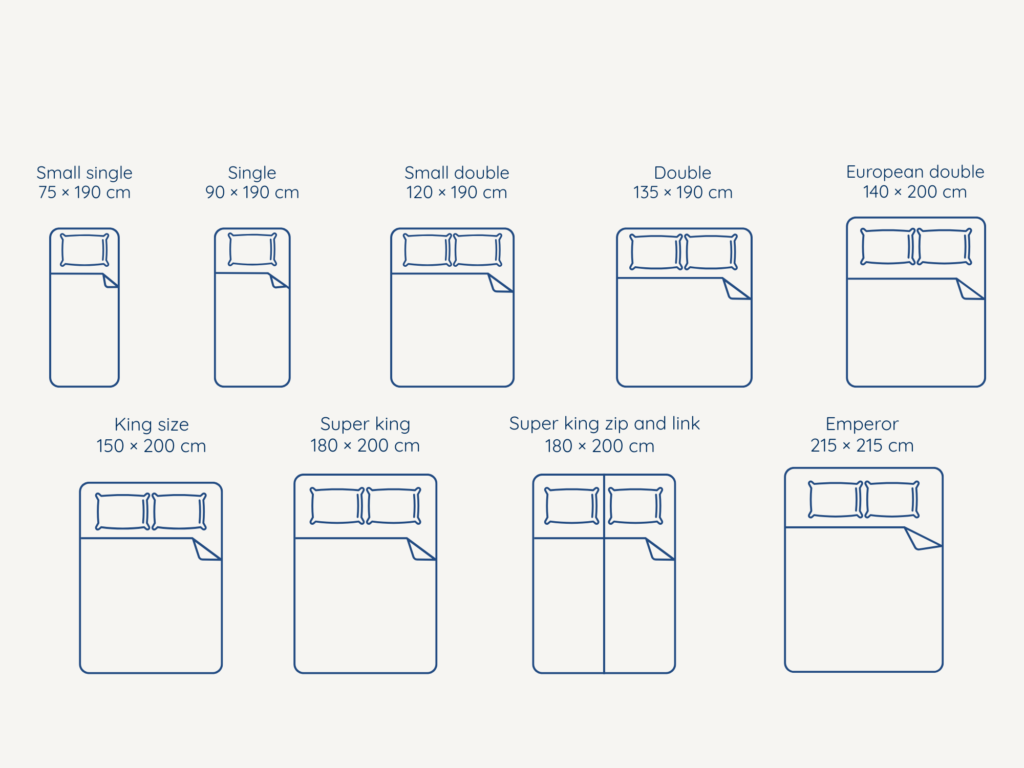
How much space does a king size mattress give each person?
The most helpful way to think about king size mattress dimensions isn’t in total centimetres, it’s in personal space. On a king size mattress, each person gets around 75cm of sleeping width.
That’s the point where most people can sleep comfortably without constantly noticing their partner’s movements. On a double, where each person has around 67.5cm, the difference sounds small but in practice it often isn’t. That slightly reduced space is usually where movement starts to be felt more easily, which is why couples tend to notice the upgrade straight away.
The extra length is talked about less, but it matters just as much for the right person. A king size mattress is 200cm long compared to 190cm for a standard double, which makes a noticeable difference for taller sleepers. As a rough guide, a double tends to suit people up to around 5ft 11in, while a king size is more comfortable up to around 6ft 3in. If you or your partner are over 6ft, the extra length alone can make a real difference to how well you sleep.
| Mattress size | Per person width | Equivalent to | What this means in practice |
|---|---|---|---|
| Double (135cm) | 67.5cm each | Less than a standard single | Movement is more noticeable, and couples are more likely to disturb each other. |
| King size (150cm) | 75cm each | More space than a double, but less than a standard single each | The point where most couples start to sleep more comfortably without regularly disturbing each other. |
| Super king (180cm) | 90cm each | Roughly equivalent to a standard single each | More generous personal space, with less awareness of movement during the night. |
| Small emperor (200cm) | 100cm each | Wider than a standard single each | Very spacious. Movement is rarely noticed and each sleeper has plenty of room. |
What room size do you need for a king size mattress?
This is the part most people don’t think about until it’s too late: whether a king size mattress will actually work in your room. It’s very easy to fall in love with the idea online, but the reality comes down to space.
The mattress itself measures 150 × 200cm, but the room you need is always more than that. You need space to walk around the bed comfortably, room to open drawers if you’re choosing a storage bed, and enough clearance to access wardrobes without everything feeling squeezed in. It’s the difference between a bedroom that feels calm and one that feels slightly cramped every time you move around it.
As a general guide, a king size bed works best in a room of around 3.5m × 3.5m. This gives you enough space around the mattress for comfortable movement without the room feeling tight.
| Mattress size | Mattress dimensions | Recommended minimum room | Notes |
|---|---|---|---|
| Double | 135 × 190cm | 3.0m × 3.5m | A versatile option for smaller bedrooms |
| King size | 150 × 200cm | 3.5m × 3.5m | Check wardrobe doors and walkways open comfortably |
| European king | 160 × 200cm | 3.5m × 3.5m | Wider than a UK king size, so check clearance carefully |
| Super king | 180 × 200cm | 4.0m × 4.0m | Measure carefully before ordering, as this is a large mattress |
Before you order, take a moment to measure your room at its widest points. It’s also worth noting where doors and windows sit, and checking that wardrobe or ensuite doors can open properly once the bed is in place.
A king size that technically fits on paper but leaves no space to move around it can end up making the room feel more cramped, not better.
Mattress depth and why it matters
Width and length tend to get most of the attention, but mattress depth matters just as much, just for slightly different reasons.
Mattress depth is simply how tall the mattress is from base to sleeping surface. It’s usually measured in centimetres and can range from around 15cm for basic rolled mattresses up to 35cm or more for premium, hand-crafted designs with deeper comfort layers.
It’s one of those details that’s easy to overlook, but it has a real impact on how the mattress feels and how it works in your space. There are three main reasons it matters
| Depth range | What it typically indicates | Fitted sheet needed |
|---|---|---|
| 15–20cm | Entry level or rolled mattresses with lighter comfort layers | Standard sheets (around 25cm depth) |
| 20–25cm | Mid range mattresses with a reasonable comfort layer above the support core | Standard to deep sheets (25–30cm) |
| 25–30cm | Premium designs with more substantial natural or foam comfort layers | Deep sheets (30–35cm) |
| 30cm+ | Luxury mattresses with thicker comfort layers, often using natural fillings and more detailed construction | Extra deep sheets (35cm+) |
What is a European king size mattress?
This is one of the most common mistakes people make when buying a mattress, and it’s worth getting clear on before you order.
A European king size mattress measures 160cm × 200cm, which makes it 10cm wider than a standard UK king size while keeping the same length. It’s the size used by IKEA bed frames and many other European bed manufacturers, so it tends to come up more often than people expect.
A UK king size mattress will leave a visible gap of around 10cm within the frame. It won’t just look off, it can also affect how the mattress sits over time and create a less even sleeping surface.
It’s always worth checking the internal dimensions of your bed frame before ordering, especially if you’re mixing UK and European products.
| Type | Width | Length | When you need it |
|---|---|---|---|
| UK king size | 150cm | 200cm | Standard UK bed frames |
| European king size | 160cm | 200cm | IKEA and European manufactured bed frames |
| US king size (Eastern) | 193cm | 203cm | Imported US bed frames, uncommon in the UK |
If you’re not completely sure which size your bed frame needs, the simplest way to check is to measure the internal sleeping platform rather than the outer frame. That measurement will tell you exactly which mattress size to go for.
At Land of Beds, we stock both UK and European king size mattresses across all constructions and tensions, so you’ve got plenty of choice either way. And if you’re unsure, just give us a call on 01928 242829. It’s something we help customers with every day.
What is a king size zip and link mattress?
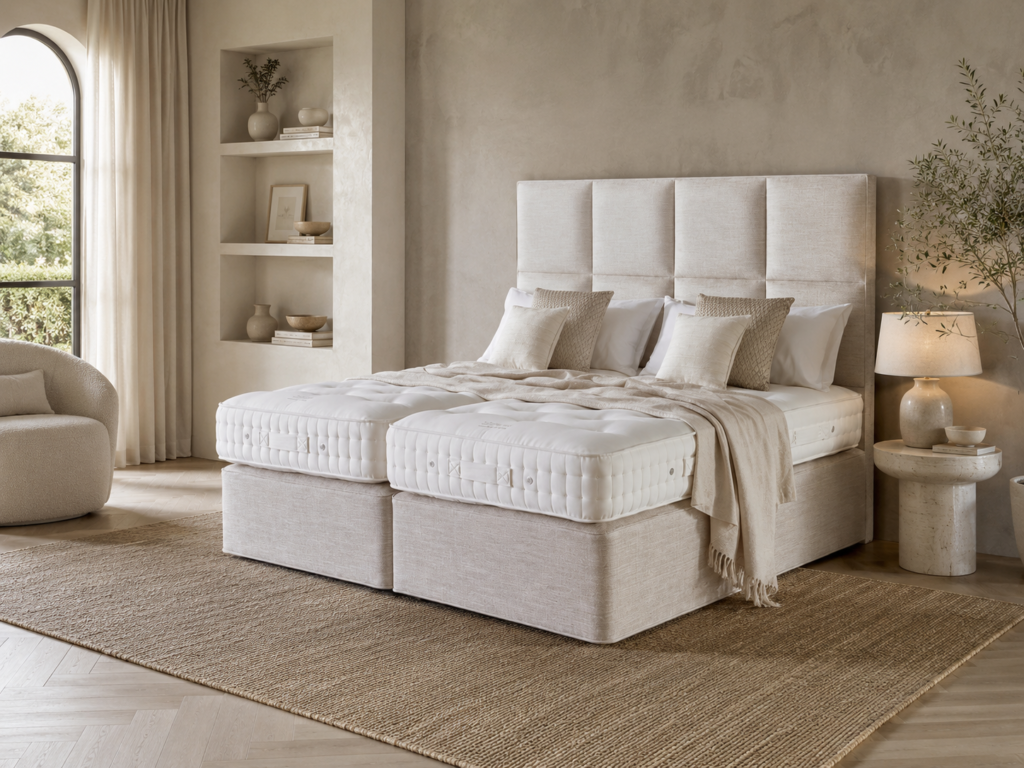
A zip and link king size mattress is made up of two separate mattresses, each measuring 75cm × 200cm, joined together to create a full king size sleeping surface. Once connected, it looks and feels like a single mattress, but each side can be a completely different tension.
For couples with different support needs, it’s one of the most practical options available. One person can choose a firmer feel for back support, while the other can opt for something softer to relieve pressure at the hips and shoulders, without either having to compromise.
There’s also a flexibility to it that standard king size mattresses don’t offer. Each side can be unzipped and used separately if needed, and when it comes to replacing the mattress, you can update one side at a time rather than replacing the whole thing.
What bedding size do you need for a king size mattress?
| Item | Standard UK king size dimensions | Notes |
|---|---|---|
| Fitted sheet | 150 × 200cm, depth typically 25–40cm | Check the depth rating matches your mattress and any topper. Deep pocket sheets are usually needed for mattresses over 28cm. |
| Flat sheet | Typically 240 × 260cm | Designed to tuck under the mattress on all sides with a comfortable amount of overhang. |
| Duvet / quilt | Typically 225 × 220cm or 230 × 220cm | The extra width is intentional and gives both sleepers enough coverage. It is usually best not to size down. |
| Pillowcases | Standard 50 × 75cm or Oxford with border | The same as other UK sizes. Pillow size is not affected by mattress size. |
| Mattress protector | 150 × 200cm, depth 25–40cm | Should match your mattress depth and sits directly on the mattress under the fitted sheet. |
| Mattress topper | 150 × 200cm | Sits on top of the mattress under the fitted sheet. Remember to include topper depth when choosing fitted sheets. |
It’s also worth knowing that European bedding ranges can be more limited and often slightly more expensive, so it’s something to factor in when deciding which size is right for you.
Is a king size mattress right for your bedroom?
King size mattress FAQs

Written by Alice Littler
Alice brings a background in marketing, design, and branding to Land of Beds, where she focuses on making sleep advice simple, relatable, and practical for everyday life. She holds a degree in Graphic Design with a specialism in branding and design, giving her a strong understanding of how interior spaces, colour, layout, and environment can influence comfort, mood, and overall wellbeing.
Her creative background allows her to provide both expert bed and mattress guidance and bedroom design inspiration that helps customers create spaces that feel as good as they look.
Alongside her work in marketing and branding, Alice has collaborated with internationally recognised brands including Campari and Aperol, Paulaner, and Malfy, helping develop her expertise in consumer-focused communication and lifestyle content. She has also been trained by and works closely with leading UK bed and mattress manufacturers including Harrison Spinks, Hypnos, and Vispring, building extensive knowledge of mattress technology, sleep ergonomics, bedroom comfort, and sleep wellness.
Passionate about the life-changing impact of quality sleep, Alice creates content designed to help readers make informed decisions to improve their sleep environment, wellbeing, and everyday routine.
Approved by
Judith brings her background in psychology, neuroscience, and education to her role at Land of Beds, where she shares expert advice to help customers sleep better. From product buying guides to bedtime routines and sleep-friendly habits, Judith’s insights support Land of Beds’ mission to improve sleep for everyone.