

How Well Is Britain Really Sleeping?
Britain is exhausted, but we’re not sleeping. Our 2026 nationwide survey of 2,004 UK adults shows a country stuck in late-night scrolling, money stress, and restless routines. While most of us believe we’re getting “enough” sleep, the data tells a very different story.
Only 27.9% of Brits achieve the recommended seven or more hours per night. Just 14.3% wake up feeling consistently refreshed. And an overwhelming 91% admit to using screens before bed, a habit proven to disrupt sleep quality.
From Yorkshire emerging as the UK’s most sleep-deprived region to Londoners unexpectedly clocking the most hours, this year’s report uncovers not just how long Britain sleeps but why so many of us still wake up tired.
Stress, money worries, work pressures, caffeine habits and bedtime procrastination are shaping a nation that is, quite simply, worn out but wired.
Here’s what the data reveals about the true state of sleep in the UK.
Bedtime Behaviours: When Does Britain Actually Go to Bed?
If your lights go out between 10 p.m. and midnight, you’re in good company. 68.6% of the UK settles down during this window, with the sweet spot being 10–10:59 p.m., when 34.6% of people go to bed.
Most of us are creatures of habit: 78.9% stick to roughly the same bedtime each night, with men (80.2%) slightly more consistent than women (77.8%). But consistency doesn’t always equal enough sleep. Almost one in five people are still awake past midnight, while only 12.7% manage to fall asleep before 10 p.m.
There are some clear differences between the sexes when it comes to timing. Women tend to turn in earlier, with 36.9% going to bed at 10pm compared to 31.8% of men. Men, on the other hand, are more likely to be night owls, with 21.1% regularly staying up past midnight versus 16.8% of women.
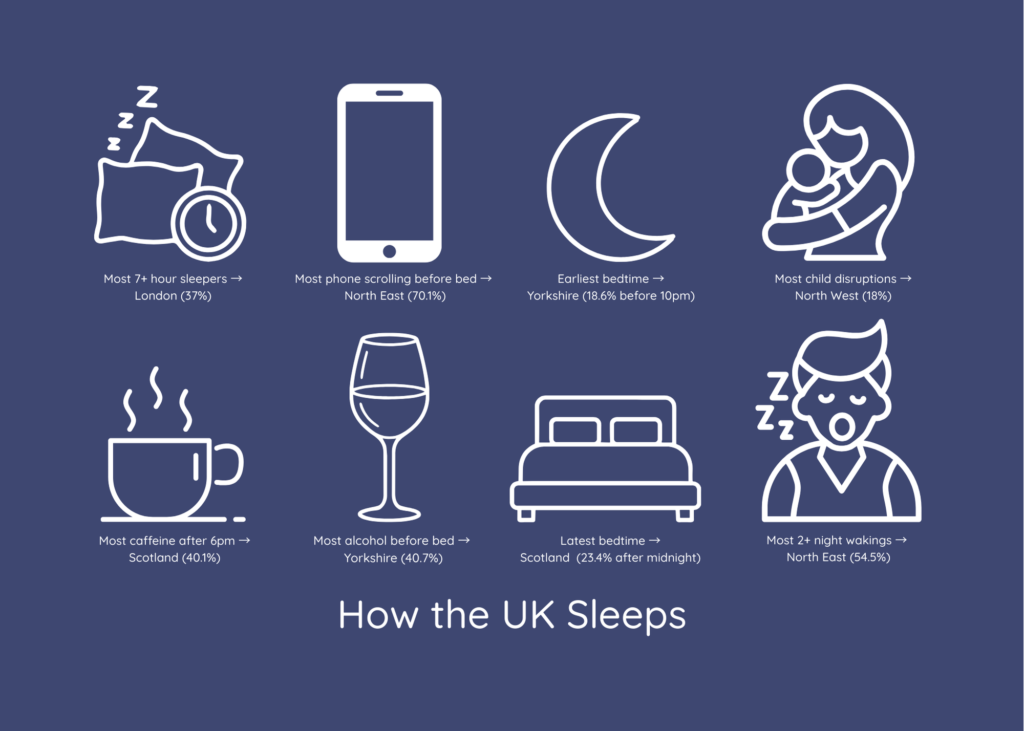
Where you live also plays a role. In the East Midlands, East of England, North East, North West, South East, Wales, and Yorkshire, most people tuck themselves up by 10:59pm. In contrast those in London, Northern Ireland, Scotland, South West, and West Midlands tend to head to bed between 11:00-11:59pm. Scotland tops the late-night league, with 23.4% of people often sleeping after midnight. Yorkshire goes to bed the earliest, with 18.6% falling asleep before 10pm.
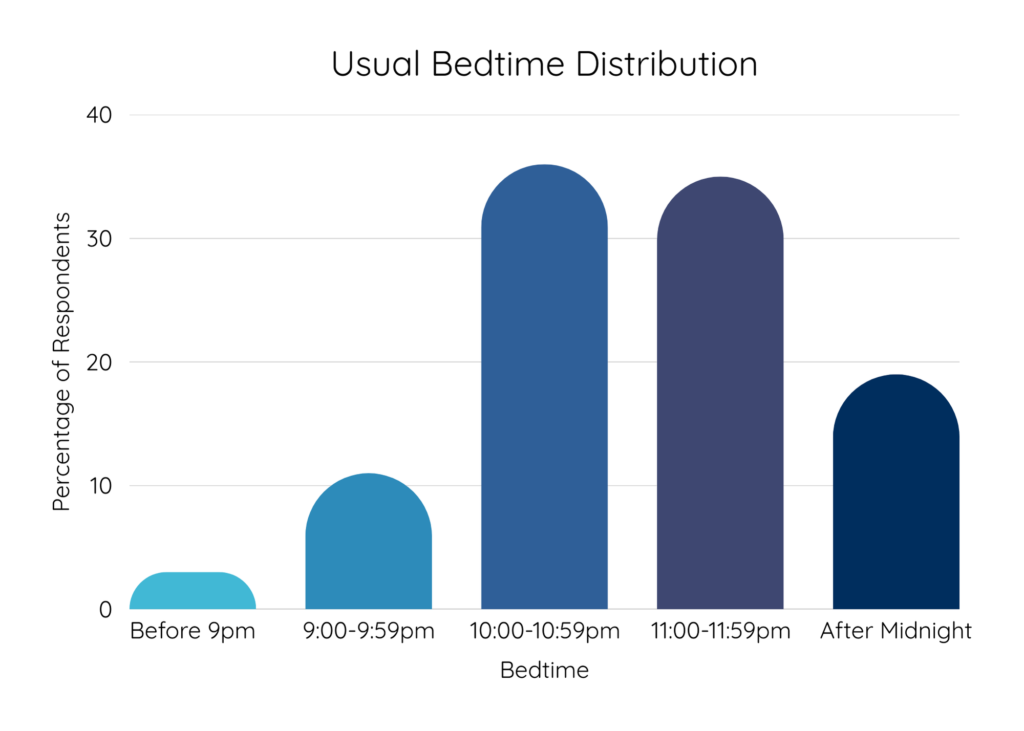
Despite these patterns, most of us aren’t getting enough rest. Only 27.9% achieve the recommended seven or more hours a night. 40.5% of the nation gets six to seven hours, while 24.9% manage just five to six hours. A small but significant 6.7% sleep fewer than five hours.
The impact is immediate. Only 14.3% wake feeling genuinely refreshed, while nearly 45% describe themselves as fairly tired or exhausted in the morning. Women suffer the most: 52% wake tired, compared with 37% of men, and only 10.1% of women feel very refreshed on waking, versus 19.4% of men.
Dr Katrina O’Donnell, a GP with over 30 years of experience known for her compassionate, practical approach to patient care, explains the long-term consequences of sleep deprivation: “Consistently getting fewer than seven hours of sleep doesn’t just leave you feeling groggy. Over time, sleep deprivation is linked to increased risk of high blood pressure, weakened immunity, weight gain, and low mood. Most adults need between seven and nine hours to allow the body to properly repair and regulate itself, and it’s one of the most important things you can do for your overall health.”
And here’s a surprising finding. London is known as the city that never sleeps. Yet it ranks as the best-sleeping region in the UK! On average, 37% of Londoners sleep more than seven hours a night.
Meanwhile, Yorkshire goes to bed the earliest. Yet it has the highest share of very short sleepers. Some 9.6% get under five hours. Going to bed early, it turns out, is no guarantee of actually sleeping well.
Night Disruptions: Why We Keep Waking Up
Even when we do manage to get to bed at a decent hour, staying asleep is another challenge altogether.
Nearly 88% of people wake at least once during the night, and almost half (48%) wake two or more times. Women (89%) are slightly more likely than men (86%) to experience these disruptions, though neither group is doing particularly well.
Regionally, the North East has it worst, with 54.5% of people waking two or more times a night, followed by Yorkshire (52.7%) and the East of England (52.1%).
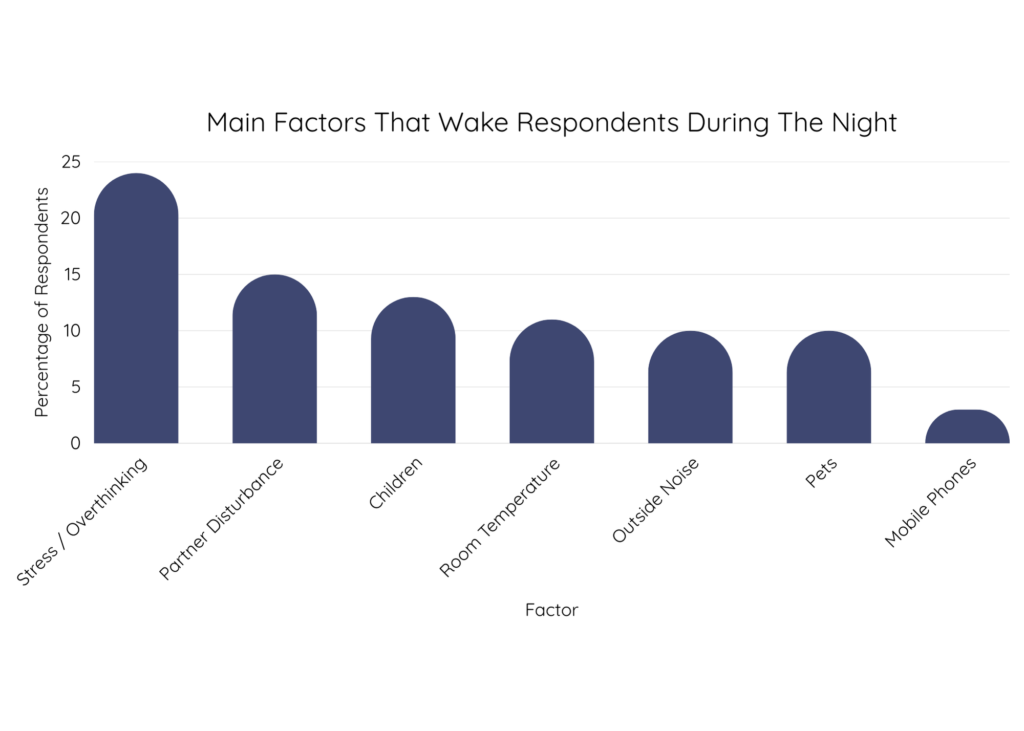
So what’s actually waking us up? Stress and overthinking comes in as the number one culprit across the board (24.4%), which perhaps isn’t surprising given the world we’re living in. After that, it’s disturbances from partners (15.3%) and children (13.3%) that are most to blame, followed by room temperature (10.5%), outside noise (10.4%), and pets (9.7%). Mobile phones only account for 2.9% of reported wakings.
Still, as we’ll explore later, screens may affect sleep.
Stress tops the list in every single region, but it’s felt most acutely in the East Midlands, where 28.1% name it as their primary reason for waking. For those being kept awake by little ones, the North West has the highest rate of child-related disruptions (18%), while partners are most likely to be the culprit in the South West (18.6%).
Stress: The Biggest Sleep Saboteur of All
We’ve established that stress is the leading cause of broken sleep across the UK, but what exactly is causing that stress? When we dug into the causes, the answers were pretty telling:
- Money (33.7%)
- Family or relationships (19.5%)
- Work (17.9%)
- Health (10.8%)
- News or current events (2.2%)
- Social media (1.2%)
- Other or no bedtime stress (14.7%)
Financial worry is the dominant theme, and it affects both men and women in roughly equal measure, with 34.9% of women and 32.2% of men identifying money as their primary source of stress at bedtime. Wales has the highest rate of money-related anxiety at 40.1%, followed jointly by Northern Ireland and the South East at 38.9%.
It’s worth noting that while social media and the news register relatively low as direct stress triggers at bedtime, the way we consume them before sleep may still be doing damage, something we’ll explore in the following section.
Wind-Down Behaviours: How Britain Prepares for Sleep
This is where things get a little uncomfortable as it’s clear that pre-bedtime habits are influencing sleep quality.
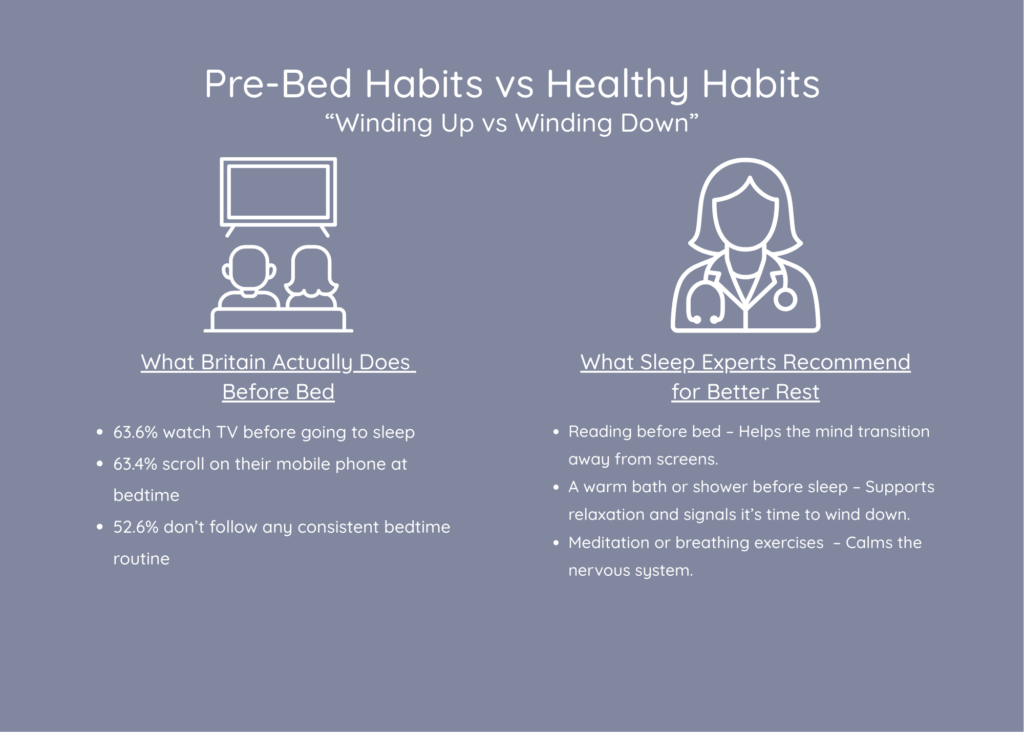
Over half the nation (52.6%) doesn’t follow any kind of consistent bedtime routine, and the two most popular pre-bed activities are watching TV (63.6%) and scrolling on a mobile phone (63.4%). Compare that to the healthier alternatives: reading (30.7%), taking a warm bath or shower (25.3%), drinking herbal tea (9.4%), meditation or breathing exercises (7.4%), and exercise (5.5%), and it’s clear that most of us are winding up rather than winding down.
Sleep expert Dr Nerina Ramlakhan has spoken previously to us about exactly why this matters: “A significant reason why so many are going to bed too late and not waking up energised is nighttime scrolling and looking at social media and the news. When people go onto their electronic devices before bedtime, the nervous system becomes over-stimulated, often causing them to worry about work or the state of the world or they compare themselves and their lives with what they see on social media which creates feelings of low self-esteem and self-worth. None of this is conducive to getting a good night’s sleep.” (The Shocking Sleep Habits Keeping Britain Awake)
And the numbers back this up entirely. A striking 91% of people use a device before sleep. Nearly half (43.6%) use it for more than 30 minutes. One in five (20.3%) use screens for over an hour before bed.
Regionally, the North East has the most screen-heavy bedtime habits, with 70.1% scrolling on phones before bed and 65.9% watching TV. Londoners, on the other hand, seem to have cracked a healthier approach: 34.1% read before bed, 35.9% take a shower or bath, 20.4% drink herbal tea, 16.2% practise meditation or breathing exercises, and 11.4% exercise in the evening – the highest rates for most of these habits across all regions.
Diet and Sleep: What We’re Eating and Drinking Before Bed
What we put into our bodies in the hours before sleep can have just as much of an impact as what we’re watching on our phones.,
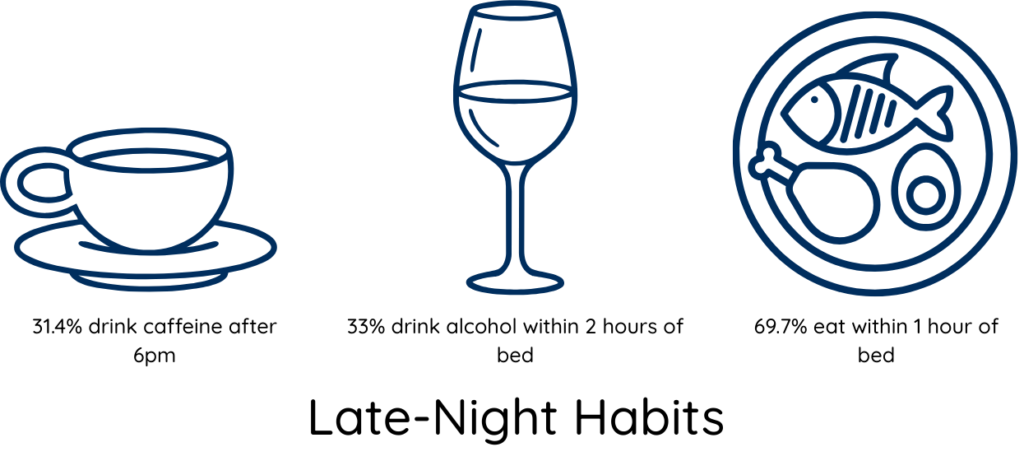
Nearly a third of people (31.4%) are drinking caffeine after 6pm. Now, caffeine works by blocking adenosine, which is the chemical your body produces to make you feel sleepy, while simultaneously increasing adrenaline and cortisol, two things you really don’t want more of at bedtime. Scotland (40.1%), Yorkshire (38.3%), and Northern Ireland (35.9%) are the biggest culprits when it comes to late-night caffeine consumption.
When it comes to alcohol habits, a third of people (33%) drink alcohol within two hours of going to bed, and over half (51.8%) have two or more drinks in an evening. Yorkshire (40.7%), the North East (38.9%), and Scotland (37.1%) report the highest rates of drinking close to bedtime.
While a nightcap might feel like it helps you relax, alcohol actually suppresses REM sleep, which is the deep, restorative stage where your brain processes memories and emotions. It also causes you to wake more frequently in the second half of the night as your body metabolises the alcohol, which explains why a night out often leaves you feeling far more tired the next morning than a night in.
Dr Katrina O’Donnell adds, “Many people use alcohol to help them fall asleep, and while it can make you feel drowsy initially, it significantly disrupts sleep quality. Alcohol suppresses REM sleep and acts as a diuretic, making you more likely to wake in the night. Regularly drinking before bed can also increase your risk of developing insomnia over time.”
And then there’s food. A significant 69.7% of people admit to eating within an hour of going to bed. When you eat close to bedtime, your digestive system has to keep working at a time when your body is trying to slow down and prepare for rest, which can lead to discomfort, acid reflux, and lighter, more disrupted sleep. Northern Ireland tops the late-night snacking charts (76.7%), followed by London and Scotland (both 74.9%).
Sleep Aids and Interventions: What Are We Trying?
With sleep this disrupted, it’s no surprise that 63.6% are turning to sleep aids.
Blackout curtains or blinds are by far the most popular choice (33.3%), particularly in the North East (41.3%), the North West (37.1%), and London (34.1%). After that, the most used sleep aids are:
- Fans (13.5%)
- Supplements such as magnesium or melatonin (12.1%)
- Eye masks (12%)
- Earplugs (10.3%)
- White noise apps or machines (9.9%)
- Heated blankets or electric throws (9.8%)
- Sleep trackers or apps (8.8%)
Women are considerably more likely than men to actively try to improve their sleep, with 67.4% using at least one sleep aid compared to 58.9% of men, which may reflect the fact that women are more likely to report poor sleep quality in the first place.
Wider Sleep Patterns: Lie-ins, Snoozing, and Naps
For many of us, the weekend lie-in is practically sacred, and the data confirms it. More than half of people (51.8%) wake at least an hour later on weekends, with Londoners being the most devoted to the practice (81.4%), followed closely by Northern Ireland (78.7%) and the East of England (77.9%). Women (75.7%) are more likely than men (71.4%) to indulge in a weekend lie-in.
During the week, it’s a different picture, with alarm-battling very much the norm. More than half of people (56.1%) hit snooze more than once in the morning, and 23.8% press it two or three times. London leads the way here too, with 72.5% of people pressing snooze and 35.3% doing so more than twice. The North West isn’t far behind, with 60.5% regularly hitting snooze.
As for chronotypes, the nation is fairly evenly divided: 41.5% identify as early birds, 39.2% as night owls, and 19.3% as neither. Men show a slightly stronger preference for being early birds (43.8%), while women split almost evenly between early birds (39.6%) and night owls (39.3%).
Napping divides opinion too. Men are slightly more likely to nap (46.5%) than women (39.2%), and when people do nap, most aim for somewhere between 30 minutes and an hour (27.7%). Londoners nap the most, with 51.5% napping one to two times a week and 6% doing so three or more times. Wales is firmly anti-nap territory, with 65.3% of people saying they never nap at all.
Sleeping Positions: How Britain Lies Down
It might seem like a small detail, but sleeping position can affect everything from snoring and back pain to how rested you feel in the morning.
Across the UK, side sleeping reigns supreme, with between 66% and 83% of people in every region falling asleep on their side. Back sleeping is the next most popular position, particularly in the North West (18%), the East of England (17.4%), South East (16.2%), and Yorkshire (16.2%). Front or stomach sleeping is the least common, generally below 20% in most regions, though London (19.8%) and Northern Ireland (15.6%) are slightly higher than average.
Dr Katrina O’Donnell notes, “How you sleep might seem minor, but it really matters. Side sleeping, which most people do, can reduce snoring, support digestion, and keep your spine comfortable. Back sleeping works for some, though it can worsen snoring, and sleeping on your front can strain your neck and back. Paying attention to your sleeping position can help you wake feeling more rested and pain-free.”
Conclusion: Britain Needs Better Sleep, and the Good News Is We Can Do Something About It
Our CEO Mike Murray, commented on the findings, saying: “We believe sleep is the foundation of physical health, mental wellbeing and daily performance. Our study highlights just how many factors, from stress about money to daily routines, influence the quality of our rest. By understanding these habits and regional differences, we can start having a more informed national conversation about sleep and empower people to make small, practical changes that have a big impact on how they feel every day.”
The picture painted by our 2026 UK Sleep Report is clear. Most of us aren’t getting the restful sleep we need. Habits like late-night scrolling, evening caffeine, alcohol, or eating too close to bed make it worse. Sleep quality and morning fatigue particularly affect women, and although patterns vary across regions, these challenges span the nation.
The good news is that most of the factors disrupting our sleep are within our control. Even small changes to your evening routine can make a real difference.
- Try leaving your phone aside one hour before bed.
- Swap that late coffee for a caffeine-free drink.
- Give yourself a proper wind-down period.
You might just wake up feeling more like yourself.
Your sleep environment also makes a real difference to how well you rest, and your bed is at the centre of that. A mattress that supports your body properly and eases pressure points can help you sleep more comfortably and wake up feeling refreshed.
Sleep well, and your body, mind, and mood will thank you – because better sleep isn’t a luxury, it’s a cornerstone of good health.
Methodology
The Land of Beds UK Sleep Report 2026 is based on a survey of 2,004 UK adults aged 18 and over. The research was conducted to provide a nationally representative snapshot of sleeping habits across the United Kingdom. The study was conducted in February 2026 and the data was analysed to identify national trends as well as differences by gender and region.
To ensure balanced regional representation, 167 respondents were surveyed in each of the following UK regions: East Midlands, East of England, London, North East, North West, Northern Ireland, Scotland, South East, South West, Wales, West Midlands and Yorkshire and the Humber.
The survey explored a wide range of sleep related behaviours and attitudes, including bedtime routines, sleep duration, night waking, stress factors, wind-down habits, diet and caffeine consumption, use of sleep aids, napping, chronotypes (early birds vs night owls) and sleeping positions.
All figures are based on self-reported responses. Percentages have been rounded to one decimal place where necessary.
About Dr Nerina
Dr Nerina Ramlakhan is a physiologist and renowned sleep expert with over 25 years of experience helping people and organisations improve their sleep, resilience, and wellbeing.
Early in her career, she observed how modern life – driven by technology, globalisation and relentless pressure – was leaving many of her clients exhausted, burned out, and disconnected.
Her work is deeply rooted in both science and lived experience. After facing her own personal challenges, including a diagnosis of bipolar disorder and complex PTSD in her early 30s, Dr Nerina embarked on a profound healing journey. Through this, she discovered the power of making different choices and now uses that insight, along with science and philosophy, to help others sleep more deeply, overcome adversity and rediscover joy in everyday life.
About Dr O’Donnell
Dr O’Donnell is a retired GP with over 30 years of experience in general practice. She qualified in 1987 from the Royal College of Surgeons in Dublin, Ireland, and began her medical career as a House Officer at Whiston Hospital in Merseyside.
In 1988, she broadened her clinical experience by working at the Royal Brisbane Hospital in Australia. After returning to the UK, she completed three years of GP training and joined a partnership in 1993, where she provided dedicated patient care until her retirement in December 2023.
Dr O’Donnell is known for her practical, compassionate approach and her deep commitment to patient education and preventative health.
In her spare time, she enjoys reading, cooking, theatre, hiking, and has a strong interest in interior design.
About Mike Murray
Mike Murray is one of the UK’s leading authorities on beds and mattresses, bringing over 20 years of specialised experience and a family heritage spanning three generations.
He blends practical craftsmanship with scientific insight to help people overcome common sleep issues such as:
- Waking stiff or sore
- Overheating at night
- Discomfort from poor support
- Partner movement disturbance
Mike holds a Bachelor’s degree in Sport Science and Psychology, as well as a Master’s in Marketing, equipping him to explain in clear, practical terms how mattresses influence spinal alignment, temperature regulation, and overall sleep quality.
Written by Judith Ackers
Judith brings her background in psychology, neuroscience, and education to her role at Land of Beds, where she shares expert advice to help customers sleep better. From product buying guides to bedtime routines and sleep-friendly habits, Judith’s insights support Land of Beds’ mission to improve sleep for everyone.