Insights from Dr Katrina O’Donnell, retired GP with over 30 years of clinical experience
Most people have looked in the mirror after a run of bad nights and clocked it immediately. The darkness under the eyes. The skin that looks like it needs a good wash even though you’ve just had one. The eyes themselves, slightly glassy, giving you away immediately. It’s one of those things your face does that no amount of concealer entirely fixes.
But there’s a difference between a bad week and a pattern. A bad week looks rough and then, mercifully, you catch up and recover. A month of broken sleep is something else. Six months is something else again. And a full year of consistently poor sleep sits in a different category entirely, one that reaches well beyond how you look and into how your body is actually functioning.
Most people broadly understand that poor sleep makes them feel groggy the next day. Fewer understand what it is doing at a physiological level, and fewer still have thought seriously about the compounding effect of month after month of disrupted or insufficient rest.
About this research
Our 2026 sleep survey found that only 27.9% of people in the UK achieve the recommended seven or more hours per night, and just 14.3% wake up feeling consistently refreshed. We worked with Dr Katrina O’Donnell to map the physiological and visible changes at three distinct stages: one month, six months, and one year. These time points are illustrative rather than exact, the effects of poor sleep vary depending on sleep quality, age, overall health and individual circumstances.
What does one month of poor sleep do to your appearance?
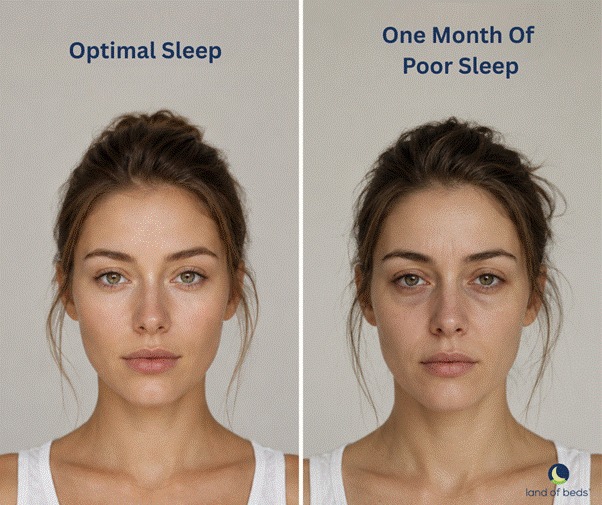
A month feels like a relatively short window, but the body registers sleep debt faster than most people expect. The changes in the mirror are already there.
The under-eye area has darkened and taken on a slightly puffed quality. The skin has lost luminosity. There’s a grey, deflated quality to the complexion that no amount of concealer fixes, because the problem is not on the surface.
“The face is remarkably honest about sleep. After a month, the under-eye area darkens and puffs up as blood vessels dilate and fluid pools overnight instead of draining properly. The skin loses its glow because the renewal that should be happening while you sleep is being cut short. Stress hormones rise with sleep deprivation and those hormones break down collagen, so fine lines start to look more pronounced than they did a few weeks ago. Patients would tell me they looked grey or flat and they weren’t imagining it. Reduced blood flow to the skin does exactly that. It’s the kind of dullness that no amount of skincare can compensate for, because the problem isn’t on the surface.”
KO
Dr Katrina O’Donnell
Retired GP, 30+ years NHS experience. Medical reviewer, Land of Beds
The face, in other words, is reporting on something internal. And at one month, that internal picture is already more troubled than most people would expect.
“A month doesn’t sound like long, but the body feels it sooner than most people expect. Patients would come into the surgery after a few weeks of broken sleep already more prone to infections and slower to recover than they normally would. That’s not a coincidence. The immune system is working below its best, the body’s stress response isn’t switching off when it should, and the natural repair work that happens while you sleep is being cut short night after night. Appetite changes too, and earlier than people realise. The cravings for carbohydrates and sugar that come with poor sleep aren’t weaknesses. They’re the body trying to replace through food the energy it isn’t getting from rest.”
KO
Dr Katrina O’Donnell
Retired GP, 30+ years NHS experience. Medical reviewer, Land of Beds
Research note: A study published in the journal Sleep found that people getting fewer than six hours a night were significantly more likely to catch a cold when exposed to the virus than those sleeping seven hours or more. The immune system does a lot of its work while you’re unconscious.
“After a month, the people closest to you will probably have noticed before you do. The part of the brain responsible for rational thinking and keeping emotions in check is working under real strain. You’re quicker to snap, slower to make decisions, and tasks that should take twenty minutes start taking forty. What concerns me most is that people adapt to this as their new normal. They stop recognising it as a symptom of poor sleep and start thinking they’re just stressed, or getting older, or not coping as well as they used to. That’s the quiet danger of the first month. It’s when poor sleep starts to feel ordinary.”
KO
Dr Katrina O’Donnell
Retired GP, 30+ years NHS experience. Medical reviewer, Land of Beds
What does six months of poor sleep do to your face and body?
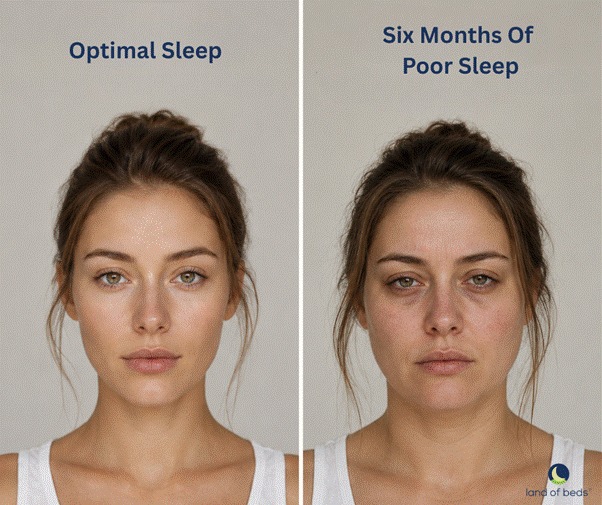
There’s a meaningful shift between one month and six. At one month, the changes are visible but still have a recoverable quality to them. By six months, something more structural is underway, and that distinction shows.
The hollowing beneath the eyes is more pronounced and has taken on a depth that looks less like tiredness and more like a permanent feature. The texture of the skin has changed noticeably. The overall impression is of a person who has been under sustained, chronic pressure for a long time, not someone who simply needs an early night.
“By six months the proteins that keep skin firm and plump are breaking down faster than the body can replace them. Texture becomes rougher and less even. Existing skin conditions like eczema, rosacea and psoriasis often flare up because of the low level inflammation that poor sleep causes. The hollowing under the eyes starts to look less like a bad week and more like a permanent feature. I always found it telling that patients would come in asking about their skin or their weight and it would turn out sleep was at the root of it. They’d been treating the symptom for months without ever addressing the cause.”
KO
Dr Katrina O’Donnell
Retired GP, 30+ years NHS experience. Medical reviewer, Land of Beds
But the skin is only the part you can see. Six months in, things are shifting internally in ways that have nothing to do with how you look in the mirror. The cuts that take slightly longer to heal than they used to. The cold that goes around the office and, this time, you are the one who gets it. Blood pressure creeping up with no symptoms to speak of. Most people would never connect any of that to their sleep.
“Six months in, we’re not talking about tiredness anymore. The body has been under sustained stress for long enough that things start to shift in ways that matter. Cortisol, the stress hormone, stays persistently elevated. The hormones responsible for repair and recovery fall because they depend on deep sleep to be produced properly. I’d see patients at this stage coming in with recurring infections they couldn’t shake, or noticing that minor wounds seemed to take longer to heal than they used to. Blood pressure also tends to creep upward as the body’s stress response stays switched on month after month. Most people have no idea the two were connected.”
KO
Dr Katrina O’Donnell
Retired GP, 30+ years NHS experience. Medical reviewer, Land of Beds
Then there is the weight question. They have been eating carefully, or trying to, and the scales are still moving in the wrong direction. The reason most people miss is hormonal: ghrelin, the hormone that triggers hunger, is elevated by sleep deprivation, while leptin, the hormone that signals fullness, is suppressed. The body is not failing them. It’s responding exactly as the science would predict.
“This is one of the things I wish more people understood, because it changes how they see themselves. By six months, the hormone that triggers hunger is elevated and the hormone that tells you you’re full is suppressed. So you’re genuinely hungrier than your body needs you to be, and the cravings tend to be for exactly the wrong things: carbohydrates, sugar, and salt. At the same time the body starts handling blood sugar less efficiently, which over time raises the risk of type 2 diabetes. Weight gain can occur not just as a result of your diet but as a result of sustained poor sleep.”
KO
Dr Katrina O’Donnell
Retired GP, 30+ years NHS experience. Medical reviewer, Land of Beds
The mental health picture has been shifting too, often without the person realising it’s happening at all.
“By six months of poor sleep the part of the brain that assesses threat and danger becomes more reactive than it should be and the world starts to feel harder to manage. Anxiety becomes more generalised and harder to pin on anything specific. Low mood is common, and in some cases it crosses into clinical depression. What I want people to understand is that sleep deprivation doesn’t just worsen existing mental health problems, it can be the primary cause of new ones. Treating anxiety or low mood without tackling sleep issues is only ever half the job.”
KO
Dr Katrina O’Donnell
Retired GP, 30+ years NHS experience. Medical reviewer, Land of Beds
What does a year of poor sleep look like?
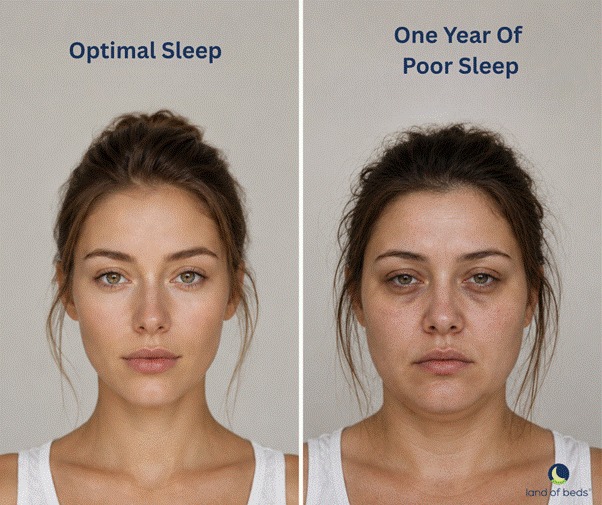
A year in, the changes are visible to people who know the person well. Not the polite kind of visible, where someone says you look tired. The kind where something is harder to put your finger on, a flatness, a loss of the quality that used to be there.
The under-eye hollowing is now deep enough that a single good night no longer shifts it. The skin has lost firmness and clarity. Weight changes that were starting at six months are now visible. Beyond the face, a year shows up elsewhere. Clothes that fit differently. Hair coming out in the brush in larger amounts than it used to. Not quite looking ill. Just not quite looking like yourself.
“A year of poor sleep ages a person in ways that are visible to anyone who knows them well. The skin has lost real firmness and brightness. The shadow under the eyes has taken on a hollowed quality that doesn’t shift after a good night here and there. Hair often becomes duller and sheds more than usual because hair growth is regulated partly by the same hormones that sleep controls. Weight tends to gather around the abdomen. And there’s a general loss of vitality and a shift in the way a person holds themselves.”
KO
Dr Katrina O’Donnell
Retired GP, 30+ years NHS experience. Medical reviewer, Land of Beds
By this point most people have been telling themselves they just need a holiday, or that things will settle down at work, or that this is just what getting older feels like. They’ve adapted so completely to feeling this way that they’ve stopped questioning it.
“After a year the risks become medically serious. Research consistently shows that people sleeping fewer than six hours a night over prolonged periods have significantly elevated risks of heart disease, type 2 diabetes and high blood pressure. After a year of poor sleep, we’re not talking about feeling tired anymore. We’re talking about real, measurable changes to how your body’s systems are functioning, and those changes cannot simply reset overnight when you eventually start to get a better night’s sleep.”
KO
Dr Katrina O’Donnell
Retired GP, 30+ years NHS experience. Medical reviewer, Land of Beds
Research note: A systematic meta-analysis published in Biomedical Reports found sleep deprivation to be associated with a significantly increased risk of cardiovascular disease. Short sleep duration has also been independently linked to hypertension and type 2 diabetes across multiple large-scale reviews.
“The brain is one of the most affected organs from sleep deprivation. While you sleep, the brain runs its overnight clearing process, flushing out waste products that build up during waking hours, including proteins that are now linked to dementia. After a year of disrupted sleep that process is significantly impaired, causing memory and concentration to suffer noticeably. Most people have no idea any of this is happening beneath the surface. They just know they don’t feel like themselves anymore.”
KO
Dr Katrina O’Donnell
Retired GP, 30+ years NHS experience. Medical reviewer, Land of Beds
Research note: Research published in PNAS found that even a single night of sleep deprivation increases levels of amyloid beta, a protein associated with Alzheimer’s disease, in the human brain. Separate research from the University of Rochester confirmed that this clearing system operates primarily during sleep, and that its disruption is linked to heightened dementia risk.
What counts as chronic sleep deprivation?
By this point most people have been telling themselves they just need a holiday, or that things will settle down at work, or that this is just what getting older feels like. They’ve adapted so completely to feeling this way that they’ve stopped questioning it.
“We generally define chronic sleep deprivation as consistently getting less than seven hours a night over three months or more, but the number of hours is only part of the story. Quality matters just as much as quantity. I’ve had patients who were technically sleeping eight hours but waking repeatedly and never reaching the deep, genuinely restorative sleep their body needed. They were just as deprived as someone sleeping for five hours a night. If you wake up most mornings still feeling tired, that’s worth paying attention to, regardless of what time you went to bed.”
KO
Dr Katrina O’Donnell
Retired GP, 30+ years NHS experience. Medical reviewer, Land of Beds
Can the effects of long-term sleep deprivation be reversed?
The honest answer is: mostly, yes — with the important caveat that the longer the pattern has gone on, the more certain changes require more than simply sleeping better.
“Depending on how long a person’s been sleep deprived for, the majority of effects can be reversed as the body is genuinely resilient and it wants to recover. For those who address their sleep properly, mood, energy and sharpness of mind can improve within a few weeks. Skin quality can often noticeably improve within a couple of months, and blood sugar regulation and the body’s background inflammation levels can shift meaningfully within three to six months of consistent, good quality sleep.”
KO
Dr Katrina O’Donnell
Retired GP, 30+ years NHS experience. Medical reviewer, Land of Beds
“What’s harder to fully reverse are changes that have built up over many years, particularly any strain on the heart or early signs of cognitive decline, as these need broader medical support and won’t resolve on their own. But people should know that it’s never too late to start. Your body is on your side. Good sleep is one of the most powerful things you can give it.”
KO
Dr Katrina O’Donnell
Retired GP, 30+ years NHS experience. Medical reviewer, Land of Beds
When should you seek help for poor sleep?
Dr O’Donnell’s answer on this is direct, and worth reading carefully if you’ve been putting off a conversation with your GP.
“In thirty years of practice I watched patients normalise poor sleep for years before asking for help, usually because they assumed it was stress, or life, or just getting older. My advice is straightforward: if poor sleep has persisted for more than a month and it’s affecting how you function during the day, that’s already a reason to speak to your GP. If you’re relying on things such as alcohol to wind down at night, waking in the early hours unable to drift back off, or your partner has mentioned loud snoring or gasping in your sleep, don’t wait. Sleep apnoea in particular is seriously underdiagnosed and carries real risks to heart health when left untreated. Sleep is a medical issue, not a personal failing, and your GP will not think you’re wasting their time.”
KO
Dr Katrina O’Donnell
Retired GP, 30+ years NHS experience. Medical reviewer, Land of Beds
Conclusion
The striking thing about chronic sleep deprivation, as Dr O’Donnell describes it, is how quietly it works. The changes don’t arrive all at once, they accumulate slowly enough that most people absorb them without noticing, adjusting their expectations and lowering their baseline until, eventually, they look in the mirror and think something is genuinely wrong. Months or years of measurable physiological change may already have taken place by then.
If any part of this landed as familiar, that is worth taking seriously. It might mean a conversation with your GP. It might start somewhere simpler, with a proper look at the conditions in which you’re actually sleeping.
The environment matters more than people tend to think. The mattress, the temperature, the noise, the light, these aren’t peripheral details. They’re the difference between sleep that repairs and sleep that merely passes the time. Land of Beds can help you get that right, whether you’re starting from scratch or looking to understand what better sleep actually requires.
Browse all mattresses
The right mattress is the foundation of better sleep. Every type, tension, and size at Land of Beds.
Free UK delivery on orders over £100 · Expert advice on 01928 242829
KO
About the expert: Dr Katrina O’Donnell
Dr Katrina O’Donnell is a retired GP with over 30 years of clinical experience in primary care. Throughout her career she worked with patients across a wide range of health conditions, with a particular interest in the relationship between lifestyle factors and long-term health outcomes. Her clinical insights informed both the written content and the AI-generated visual comparisons used in this campaign.
Written by Judith Ackers
Judith brings her background in psychology, neuroscience, and education to her role at Land of Beds, where she shares expert advice to help customers sleep better. From product buying guides to bedtime routines and sleep-friendly habits, Judith’s insights support Land of Beds’ mission to improve sleep for everyone.
Approved by Alice Littler
Alice brings a background in marketing, design, and branding to Land of Beds, where she focuses on making sleep advice simple, relatable, and practical for everyday life. She holds a degree in Graphic Design with a specialism in branding and design, giving her a strong understanding of how interior spaces, colour, layout, and environment can influence comfort, mood, and overall wellbeing.
Her creative background allows her to provide both expert bed and mattress guidance and bedroom design inspiration that helps customers create spaces that feel as good as they look.
Alongside her work in marketing and branding, Alice has collaborated with internationally recognised brands including Campari and Aperol, Paulaner, and Malfy, helping develop her expertise in consumer-focused communication and lifestyle content. She has also been trained by and works closely with leading UK bed and mattress manufacturers including Harrison Spinks, Hypnos, and Vispring, building extensive knowledge of mattress technology, sleep ergonomics, bedroom comfort, and sleep wellness.
Passionate about the life-changing impact of quality sleep, Alice creates content designed to help readers make informed decisions to improve their sleep environment, wellbeing, and everyday routine.